

Curious whether that giant, sail like finned fish you spotted on a fishing charter actually belongs on your dinner plate? You are not alone. Every year, thousands of anglers reel in sailfish along the Florida coast and wonder the same thing. So can you eat sailfish? Yes, sailfish is edible and safe to eat when properly handled and cooked, offering a lean source of protein, omega 3 fatty acids, and essential nutrients like vitamin B12 and selenium. However, it is far less common on dinner tables than tuna or swordfish, largely because sport fishers treasure it as a prized game fish rather than a food source.
This guide breaks down everything you need to know: full sailfish nutrition facts, how it tastes, mercury and safety concerns, the real difference between sailfish and marlin, and the best ways to cook it if you decide to try it.
Yes, sailfish is completely edible and legal to eat in most places where it is caught, including U.S. waters like Florida and the Gulf Coast. The meat comes from a large, fast swimming predator, which means it is naturally lean, firm, and packed with protein rather than fat.
That said, sailfish rarely shows up in grocery stores or restaurants, and there is a good reason for that. Within the recreational fishing world, sailfish holds a special status as a premier game fish. Anglers value the fight, speed, and spectacle of hooking one far more than they value it as a meal. Because of this, a strong catch and release culture has developed around the species, especially in places like South Florida and Costa Rica, where sailfish tournaments release nearly every fish caught.
A few key points worth knowing upfront:
In short, edibility is not the issue. Availability and fishing culture are what keep sailfish off most dinner plates.
Sailfish has a mild, slightly meaty flavor that sits somewhere between tuna and swordfish, though it leans firmer and less fatty than both. The flesh is lean and dense, with a texture that some describe as steak like once cooked properly. Unlike buttery fish such as salmon, sailfish does not have a rich, oily mouthfeel, which is part of why opinions on its taste vary so much among people who have actually tried it.
Because the meat is lean and tightly muscled from constant high speed swimming, it can turn tough or dry if overcooked. This is the single biggest complaint people have about eating sailfish, and it usually comes down to preparation rather than the fish itself.
A few taste notes worth knowing:
If prepared correctly, most people find sailfish perfectly enjoyable to eat, just different from the fattier fish they may be used to.
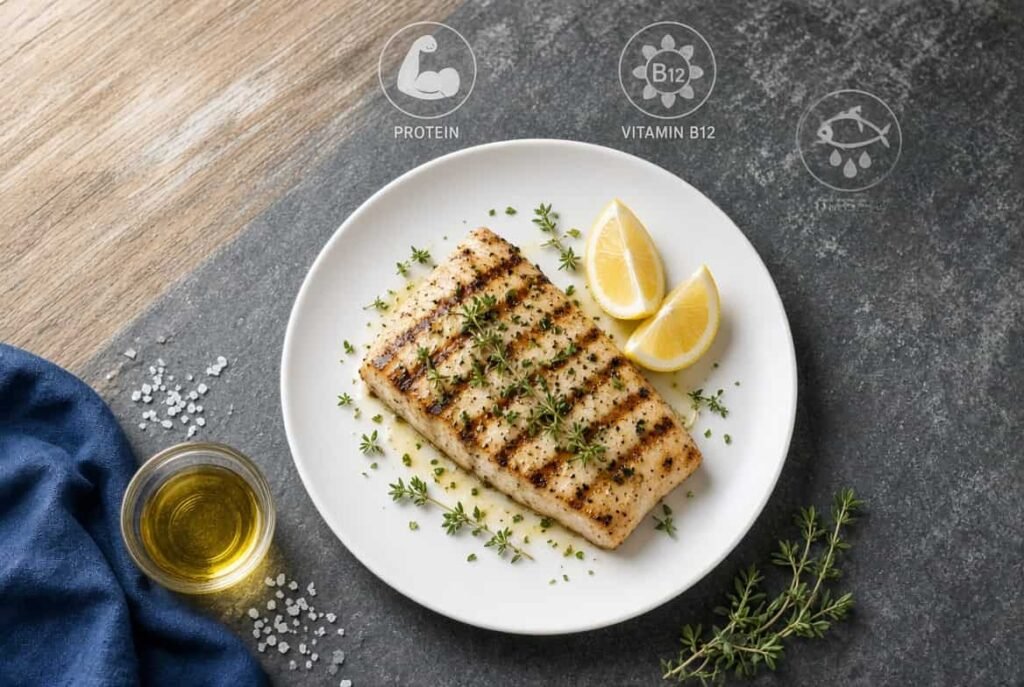
Sailfish delivers solid nutritional value for anyone tracking protein intake or looking for a lean alternative to fattier fish. A typical 100 gram cooked serving provides roughly the following:
Nutrient | Amount per 100g | Daily Value Contribution |
Calories | Approximately 110 to 120 kcal | Low calorie protein source |
Protein | 18 to 20 g | High quality complete protein |
Total Fat | 2 to 3 g | Low fat, lean profile |
Omega 3 Fatty Acids | Moderate | Supports heart and brain health |
Vitamin B12 | High | Supports nerve and energy function |
Vitamin D | Moderate | Supports bone health |
Selenium | High | Supports immune function |
Phosphorus | Moderate | Supports bone strength |
Compared to tuna, sailfish carries a similar protein punch but slightly less omega 3 content. Against salmon, sailfish is noticeably leaner, since salmon carries far more fat and omega 3s per serving. This makes sailfish a good middle ground option for people who want lean protein without the higher fat load of fattier fish.
Sailfish is generally safe to eat, but as a large predatory fish, it carries the same mercury concerns that apply to tuna, swordfish, and marlin. Understanding these risks helps you enjoy sailfish responsibly rather than avoiding it altogether.
Mercury levels. Sailfish sits high on the ocean food chain, feeding on smaller fish and squid throughout its life. This means mercury can accumulate in its tissue over time, similar to other large predatory species. Because of this, sailfish is best treated as an occasional food rather than a daily staple.
Who should be cautious. Pregnant women, breastfeeding mothers, and young children are typically advised to limit or avoid high mercury fish altogether. If you fall into one of these groups, it is worth checking current fish consumption guidelines from a health authority like the FDA or EPA before adding sailfish to your diet.
Handling and spoilage. Beyond mercury, proper handling matters just as much. Sailfish is caught in warm tropical and subtropical waters, and its meat can spoil quickly if not chilled soon after the catch. Key handling tips include:
● Bleed and ice the fish immediately after catching
● Keep the meat refrigerated or on ice until cooking
● Cook thoroughly to reduce the risk of foodborne illness
● Avoid eating sailfish that has been left unrefrigerated for extended periods, especially in hot climates
Following these basic food safety steps significantly reduces any risk associated with eating sailfish.
One common mistake in sailfish content is listing four regional types, including a separate Mediterranean sailfish. In reality, marine biologists recognize only two subspecies of sailfish worldwide, both belonging to the genus Istiophorus. Getting this right matters, since Mediterranean sailfish sightings are simply Atlantic sailfish that have wandered into Mediterranean waters, not a distinct type.
Atlantic Sailfish
The Atlantic sailfish (Istiophorus albicans) is found throughout the western and eastern Atlantic Ocean, including the Gulf of Mexico, the Caribbean, and waters off the coast of West Africa. It is known for its blue upper body, silver white belly, and the tall, sail like dorsal fin that gives the species its name. Atlantic sailfish are a major draw for sport fishers off Florida, where they are the official state saltwater fish.
Indo Pacific Sailfish
The Indo Pacific sailfish (Istiophorus platypterus) ranges across the warm waters of the Indian and Pacific Oceans, including popular fishing grounds off Central America and Southeast Asia. It is generally considered slightly larger on average than its Atlantic counterpart and shares the same core traits: blazing speed, a prominent dorsal fin, and a long spear like bill used for hunting.
Both subspecies share nearly identical biology, diet, and behavior. The primary differences come down to geographic range and minor variations in average size, not distinct physical types as often claimed online.
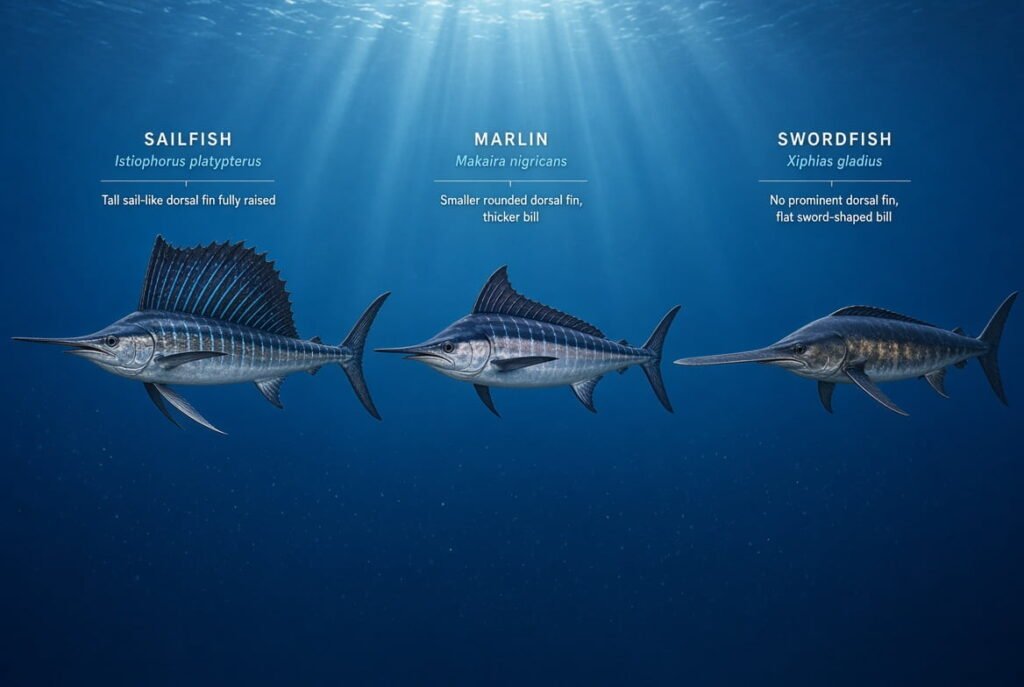
These three billfish are frequently confused, and for good reason. All three have long, pointed bills and live in similar warm ocean waters. However, they differ in several clear ways once you know what to look for.
Feature | Sailfish | Marlin | Swordfish |
Dorsal Fin | Tall, sail like, spans nearly full body length | Smaller, more rounded fin | No prominent dorsal fin |
Average Size | 6 to 11 feet, up to 220 lbs | Can exceed 14 feet, up to 1,800 lbs (blue marlin) | Up to 15 feet, up to 1,400 lbs |
Bill Shape | Long, thin, spear like | Long, thicker, rounder bill | Long, flat, sword shaped bill |
Top Speed | Up to 68 mph, fastest of the three | Slightly slower, around 50 mph | Slower, built for depth diving |
Meat Texture | Lean, firm | Firm, meatier | Dense, steak like, most commonly eaten |
Culinary Popularity | Rarely eaten, mostly catch and release | Occasionally eaten, mostly catch and release | Widely sold and eaten commercially |
The easiest way to tell them apart at a glance is the dorsal fin. A sailfish’s fin is unmistakable since it runs almost the entire length of its back and can be raised or lowered like an actual sail. Marlin have a much smaller, less dramatic fin, while swordfish lack this tall fin altogether.
In terms of eating them, swordfish is by far the most commercially popular of the three, regularly sold at grocery stores and restaurants. Marlin sees occasional consumption in some regions, while sailfish remains the least commonly eaten due to its strong sport fishing culture and catch and release tradition.
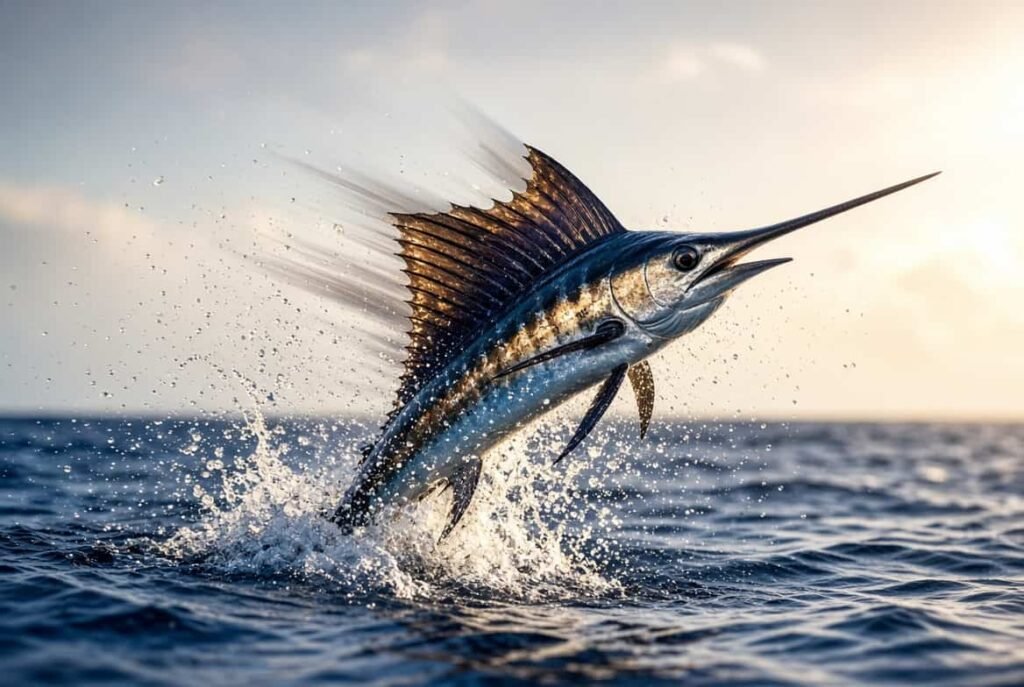
Sailfish holds the title of the fastest fish in the ocean, capable of reaching speeds up to 68 miles per hour, or roughly 110 kilometers per hour. That kind of speed comes from a combination of a streamlined, laterally compressed body, a powerful crescent shaped tail, and the ability to fold its fins flat against its body to reduce drag while sprinting after prey.
Size range. Sailfish typically grow between 6 and 11 feet long, including their bill, and can weigh anywhere from 120 to 230 pounds depending on the region and subspecies. Despite their impressive size, they grow remarkably fast, often reaching 4 to 5 feet in length within their first year of life.
World record catches. The all tackle world record for sailfish, recognized by the International Game Fish Association, stands at 141 pounds, caught off the coast of Ecuador. While size records vary slightly by region and line class, sailfish over 100 pounds are considered exceptional catches among anglers.
A few standout facts:
● Sailfish can leap dramatically out of the water, a behavior anglers often describe as one of the most thrilling parts of the fight
● Their raised dorsal fin can be taller than the fish’s own body height in some individuals
● Despite their size, sailfish have a relatively short lifespan of around 4 to 5 years in most regions, though some populations may live longer
This combination of speed, size, and dramatic behavior is exactly why sailfish remains one of the most sought after game fish in the world.
Sailfish are aggressive predators that feed primarily during daylight hours, targeting smaller schooling fish and squid. Their favorite prey includes sardines, anchovies, mackerels, halfbeaks, and small tuna, all species that tend to gather in large, tightly packed schools near the surface.
What makes sailfish hunting especially fascinating is their coordinated group behavior. Rather than chasing prey individually, sailfish often hunt in pods, sometimes with dozens of fish working together to surround a school of baitfish. Using their raised dorsal fins, they form a kind of moving wall that traps the school in place, making it harder for prey to scatter and escape.
Once the school is contained, sailfish take turns darting in to feed. Research has shown they use their long, spear like bill in a deliberate way, slashing it side to side through the school to injure or stun multiple fish at once before circling back to pick off the wounded targets. This tap and strike technique allows a group of sailfish to feed far more efficiently than hunting alone.
Key diet facts:
This combination of speed, teamwork, and a built in weapon makes sailfish one of the most efficient predators in the open ocean.
Sailfish live in tropical and subtropical waters across the globe, typically staying within a band roughly 40 degrees north to 40 degrees south of the equator. They favor warm surface waters but are capable of diving to depths of around 1,500 feet when chasing prey into deeper zones.
Atlantic range. Atlantic sailfish are found from the Gulf of Maine down through the Caribbean, Gulf of Mexico, and along the coast of Brazil, as well as across the eastern Atlantic near West Africa. Florida remains one of the most popular hotspots, particularly during the cooler months from October through March when cold fronts push baitfish southward.
Indo Pacific range. Indo Pacific sailfish range across the warm waters of the Indian and Pacific Oceans, with popular fishing grounds off Central America, Southeast Asia, and parts of Australia.
General habitat preferences:
This wide, warm water range is part of why sailfish are found on the bucket list of anglers across so many different countries and coastlines.
Despite their speed, size, and spear like bill, sailfish are not considered dangerous to humans and do not hunt or target people. Unprovoked attacks are extremely rare, and when injuries do occur, they almost always happen during the fishing process itself rather than from a sailfish acting aggressively toward a swimmer or diver.
When incidents happen. Most documented injuries involve anglers who are actively fighting a hooked sailfish at boatside. A thrashing, panicked fish can accidentally strike a person with its bill while being brought in or released, especially in tight quarters on a boat. These incidents are considered accidental rather than predatory.
Why they are not a threat to swimmers. Sailfish use their bill specifically as a hunting tool against schools of baitfish, not as a weapon against large animals or humans. They are naturally cautious around divers and tend to avoid direct contact unless provoked or hooked.
A few safety points worth knowing:
In short, sailfish pose far more of a challenge as a fighting game fish than any real threat to people in the water.
Since sailfish meat is lean and firm, the biggest rule of thumb is to avoid overcooking, which quickly dries out the flesh and makes it tough. With the right technique, though, sailfish can turn into a genuinely enjoyable meal.
Grilling. This is one of the most popular methods for sailfish since it adds char and smoky flavor while keeping cooking time short.
Baking. A gentler option that works well with marinades and herbs.
Smoking. Considered by many to bring out the best flavor in sailfish, since the low and slow process compensates for its low fat content.
Pro tip: Marinating sailfish for at least 30 minutes before cooking, using an acid like lime or vinegar combined with oil and herbs, significantly improves both flavor and tenderness. This one step addresses the most common complaint people have about eating sailfish.
Sailfish holds a special place in the sport fishing world, and nowhere is that more evident than in South Florida, where it has been the official state saltwater fish since 1975. Every year, tens of thousands of fishing trips head out specifically in pursuit of sailfish, with Florida alone accounting for well over 100,000 trips annually, far outpacing other coastal states.
Popular fishing destinations. Beyond Florida, Costa Rica and other parts of Central America are considered world class sailfish destinations, prized for consistent year round action and the sheer volume of fish in the water. Anglers travel internationally specifically to target sailfish in these regions.
Why catch and release dominates. Sailfish are widely viewed as more valuable alive than as food. Their dramatic fighting style, including spectacular leaps and long runs, makes them one of the most exciting fish to catch on rod and reel. This has led to a strong conservation minded culture within the sport fishing community, where the vast majority of sailfish caught are released back into the water rather than kept.
Key facts about sailfish fishing:
This combination of thrilling gameplay and conservation values is the main reason sailfish remains far more common on fishing charters than on dinner plates.
So, can you eat sailfish? Absolutely, and now you know exactly what that means in practice. Sailfish offers a lean, protein rich meat packed with vitamin B12, selenium, and moderate omega 3s, making it a nutritious option when prepared correctly. The keys to enjoying it are simple: handle it properly right after the catch, cook it without overdoing it, and stay mindful of mercury levels like you would with any large predatory fish.
What truly sets sailfish apart, though, is not its place on the dinner table but its place in the ocean. As the fastest fish in the sea, a coordinated hunter, and one of the most thrilling catches in sport fishing, sailfish earns its reputation as a game fish first and a food fish second. Whether you are curious about trying it yourself or simply fascinated by this remarkable species, understanding both its culinary and biological side gives you the complete picture of what makes sailfish so unique.
Is sailfish good to eat?
Yes, sailfish is good to eat when prepared correctly. Its lean, firm meat has a mild flavor similar to swordfish. The main challenge is avoiding overcooking, since the low fat content can make it dry if cooked too long.
Does sailfish taste fishy?
No, sailfish has a mild, slightly briny flavor rather than a strong fishy taste. It is often compared to tuna or swordfish, though it is leaner and firmer in texture than both of those options.
Is sailfish high in mercury?
Sailfish carries moderate to high mercury levels since it is a large predatory fish high on the food chain. It is best eaten occasionally rather than daily, and pregnant women, children, and breastfeeding mothers should limit intake.
What is the difference between marlin and sailfish?
Sailfish have a tall, sail like dorsal fin spanning nearly their full body length, while marlin have a smaller, rounded fin. Marlin also grow significantly larger, with blue marlin reaching over 1,800 pounds compared to sailfish at around 220 pounds.
How fast can a sailfish swim?
Sailfish can swim up to 68 miles per hour, or roughly 110 kilometers per hour, making them the fastest fish in the ocean. This speed comes from their streamlined body and powerful, crescent shaped tail.
What is the world record for the largest sailfish ever caught?
The IGFA all tackle world record for sailfish stands at 141 pounds, caught off the coast of Ecuador. Sailfish over 100 pounds are considered exceptional catches among recreational anglers worldwide.
Can sailfish hurt or attack humans?
Sailfish do not target or attack humans under normal circumstances. Most injuries occur accidentally during active fishing, when a hooked fish thrashes near the boat, rather than from unprovoked aggression in open water.
What do sailfish eat?
Sailfish primarily eat schooling fish like sardines, anchovies, and mackerel, along with squid. They often hunt in coordinated groups, using their bill to slash through schools and stun multiple prey at once.
Is sailfish healthier than tuna?
Sailfish and tuna offer similar protein content, though tuna generally provides more omega 3 fatty acids. Sailfish is leaner overall, making it a good choice for those prioritizing low fat, high protein meals.
Why do sport fishers release sailfish instead of eating it?
Sport fishers value sailfish more for its dramatic fight and leaping behavior than as food. This has created a strong catch and release culture, particularly in Florida and Costa Rica, where most sailfish caught are released alive.

Fish Info Guide helps you explore edible, freshwater, saltwater, and aquarium fish – with simple guides on nutrition, care, and species identification for beginners and enthusiasts alike.
Imortant Links
Quick Links
Subscribe Our Newsletter
Get the latest fish care tips, species guides, and nutrition insights delivered straight to your inbox.