

Most people assume an eel is basically an aquatic snake. That assumption is wrong, and it changes how you should think about this animal entirely.
Yes, eel fish is a true fish. It belongs to the order Anguilliformes, breathes through gills, and shares the same core biology as salmon or tuna, just wrapped in a longer, snake shaped body. Yet eels remain one of the most misunderstood creatures in the water world.
This guide answers that question fully. You will learn what makes eel fish unique, the major species worth knowing (including the electric eel, which is technically not a true eel at all), how eels reproduce in the mysterious Sargasso Sea, whether they pose any real danger, their nutrition profile, aquarium care basics, and current market pricing.
By the end, you will understand eel fish more completely than almost any other resource covering this topic today.
Yes, an eel is a true fish. Despite its long, snake shaped body, an eel breathes through gills, has a backbone, and belongs to the class Actinopterygii (ray finned fishes), specifically the order Anguilliformes. This order includes more than 800 recognized species, ranging from freshwater eels to deep sea morays.
What confuses most people is the missing pelvic fins and the smooth, scale free skin. Instead of hard scales, eels are covered in a thick protective mucus layer that lets them absorb some oxygen through the skin and even survive brief periods out of water. This is real fish anatomy, just adapted for a different lifestyle than a typical bass or trout.
Here is what separates eel fish from other fish species:
So when someone asks “is eel a fish,” the direct answer is yes, confirmed by its skeletal structure, gill respiration, and fin arrangement, even though its outward appearance invites comparisons to snakes.
The confusion is understandable. Eels swim like snakes, have no visible legs, and lack the scales most people associate with fish. But biologically, eels, snakes, and amphibians are three completely different animal groups, and the differences matter.
The clearest separator is respiration. Eels breathe exclusively through gills, extracting oxygen directly from water. Snakes breathe through lungs and must surface or stay on land to breathe air. Amphibians, like frogs and salamanders, use a mix of lungs, skin, and gills depending on their life stage, but they always need access to both water and land to complete their life cycle. Eels never leave the aquatic world in the same way; even their brief overland travel across wet grass relies on skin and gill moisture, not lung breathing.
Here is a quick comparison:
Feature | Eel Fish | Snake | Amphibian |
Breathing method | Gills | Lungs | Lungs, skin, or gills (varies by stage) |
Skin covering | Scaleless, mucus layer | Dry scales | Moist, permeable skin |
Habitat requirement | Water only | Land or water | Both land and water |
Fins vs limbs | Fins, no limbs | No limbs, no fins | Limbs (in adult stage) |
Reproduction | Spawns in ocean water | Lays eggs or live birth on land | Lays eggs in water, larvae develop there |
So is an eel a fish or a snake? It is a fish, full stop, sharing zero classification with snakes beyond superficial shape. And is an eel a fish or an amphibian? Also a fish, since it never transitions to a land breathing life stage the way amphibians do. The snake like appearance is a case of convergent evolution, where unrelated animals develop similar body shapes to suit similar environments, not proof of shared ancestry.
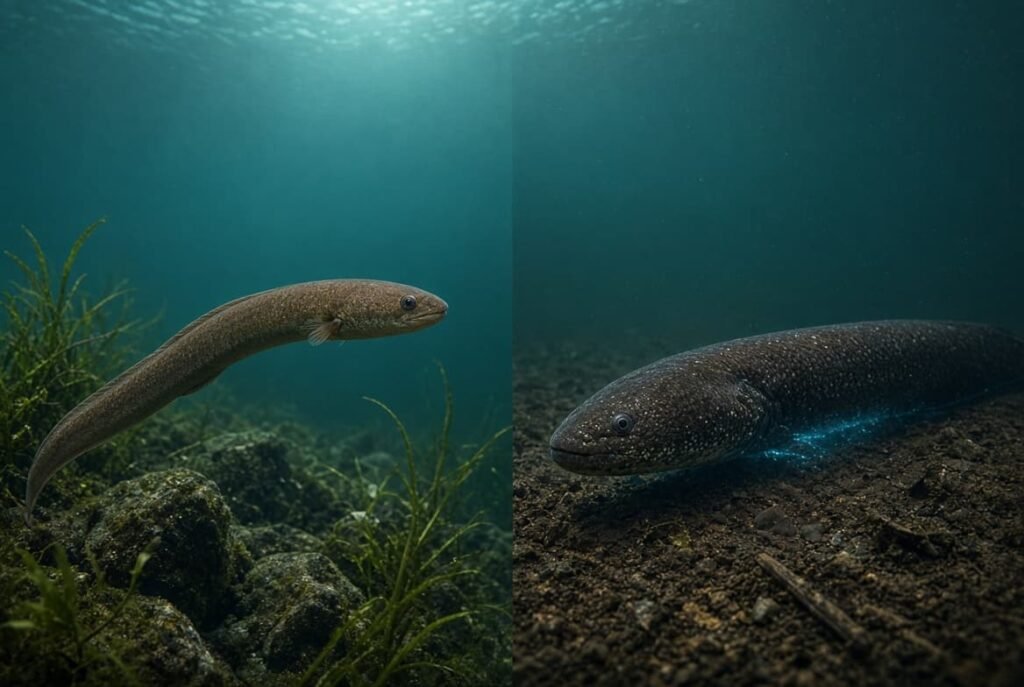
Eel fish include far more diversity than most people realize, spanning true freshwater eels, ocean dwelling morays, and one famous imposter that is not a true eel at all. Understanding these categories helps clarify why “eel” functions more as a broad shape description than a single species group.
True Freshwater Eels (Anguillidae)
These belong to the genus Anguilla and are the eels most associated with food and traditional cuisine.
Electric Eel: Why It Is Not a True Eel
This is one of the most commonly misunderstood facts in fish biology. The electric eel (Electrophorus electricus) is not classified under Anguilliformes at all. It belongs to the order Gymnotiformes, the knifefish family, and is more closely related to catfish and carp than to true eels.
Electric eels earned their eel like reputation from their long, cylindrical body shape. They generate electrical discharges up to 600 volts using specialized organs that make up roughly four fifths of their body length, using low voltage pulses for navigation and higher voltage bursts to stun prey or deter predators.
Moray Eels, Conger Eels and Reef Species
Moray eels (family Muraenidae) are instantly recognizable by their thick bodies, small rounded gill openings, and a second set of jaws in their throat used to pull prey deeper into their mouth. Popular species include the snowflake eel, ribbon eel, and yellow head moray, all common in the aquarium trade.
Conger eels (family Congridae) differ from true eels by having equal length upper and lower jaws and more vertebrae. The European conger is the heaviest known eel species, reaching around 72 kilograms.
The wolf eel, despite its name, is technically a wolffish rather than a true eel, but it is grouped here due to its eel like body and frequent search association.
Other Notable Types
Across all these types, one theme holds true: the word “eel” describes a body shape shared by multiple unrelated fish families, not a single biological group.
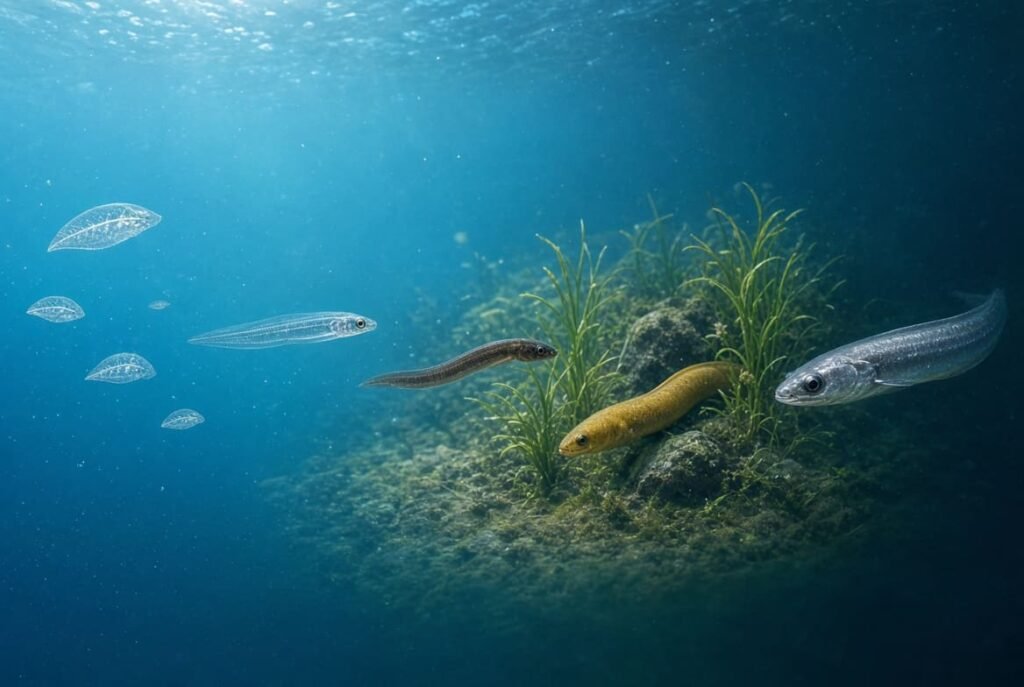
Few fish undergo a transformation as dramatic as the eel. Freshwater eels are catadromous, meaning they are born in the ocean, spend most of their lives in freshwater rivers and lakes, then return to the sea to spawn and die. This life cycle remained one of biology’s great mysteries for centuries.
The breakthrough came in 1923, when Danish biologist Dr. Johannes Schmidt discovered eel larvae in the Sargasso Sea, a unique region of the Atlantic Ocean bordered not by land but by swirling ocean currents and floating Sargassum seaweed. This confirmed that European and American eels both travel thousands of miles to spawn in the same remote nursery. In 2022, researchers finally tracked adult eels using satellite tags, confirming migrations exceeding 3,000 miles across the Atlantic.
The eel fish reproduction cycle unfolds across six distinct stages:
Scientists still cannot fully explain how eels determine their sex or what precisely triggers the return migration. Freshwater eels also cannot currently be bred in captivity, which is why all farmed eel supply depends on wild caught glass eels, a major factor behind both pricing and conservation concerns discussed later in this guide.
Eel fish are opportunistic carnivores, and their diet shifts noticeably as they move through different life stages and habitats. Understanding what eel feed consists of also explains their behavior, since most species are more active hunters at night than during the day.
In freshwater and coastal environments, eels typically prey on:
Juvenile eels tend to start with smaller prey like insect larvae and tiny invertebrates, gradually shifting toward fish and crustaceans as they grow. Some species, including certain morays, are known to be cannibalistic, occasionally preying on smaller eels of their own kind when food is scarce.
Eels are also nocturnal feeders. During the day, they typically hide under rocks, in mud, or within crevices, emerging after dark to hunt using a strong sense of smell rather than eyesight, since many species have relatively poor vision. This nocturnal hunting pattern is one reason eels are rarely seen during daytime river or reef exploration, despite being present in large numbers.
For aquarium keepers, replicating this diet matters. Captive eels generally do well on a mix of small fish, shrimp, and crustacean based pellets or frozen foods, fed in the evening to match their natural feeding rhythm.
Most eel species pose little to no threat to humans, but a few notable exceptions explain why this question comes up so often. The danger level depends heavily on which type of eel fish you are talking about.
Electric eels are the clearest example of real danger. As covered earlier, they are not true eels, but their reputation drives most searches around eel fish voltage and eel fish current. Electric eels generate two types of electrical discharge: low voltage pulses used for navigation in murky water, and high voltage bursts, reaching up to 600 volts, used to stun prey or fend off predators. A single shock at that voltage is rarely fatal to a healthy adult human, but it can cause enough shock and muscle disruption to be dangerous near water, where drowning becomes the real risk. Multiple repeated discharges pose higher risk, particularly for children, the elderly, or anyone with heart conditions.
Moray eels present a different kind of risk. They have rows of sharp teeth and a unique second set of jaws in their throat that helps pull prey deeper into their mouths. Bites usually occur when divers or fishermen provoke them or reach into crevices where morays are hiding, not from unprovoked attacks. Bites can cause deep puncture wounds requiring medical attention.
True freshwater eels, such as European, American, and Japanese eels, are generally not dangerous to humans. They lack strong venom or aggressive tendencies, though their sharp teeth can still deliver a minor bite if handled carelessly.
So is eel fish dangerous overall? For most species encountered in food markets, aquariums, or rivers, no. The real caution points are electric eels near water and moray eels in their natural reef habitat.
Beyond the biology and safety questions, eel fish has earned a lasting place on dinner tables for a reason: its nutrition profile is genuinely strong. A 100 gram serving of eel typically provides 18 to 20 grams of high quality protein, along with a substantial dose of healthy fats.
Key nutritional highlights include:
For context, a 200 gram serving of eel fish delivers roughly 36 to 40 grams of protein, comparable to a serving of chicken breast, but paired with omega 3 benefits that chicken does not offer.
This nutrient density explains why eel fish benefits show up frequently in seafood and health discussions, and why dishes like unagi sushi remain popular well beyond their taste appeal. The combination of lean protein, essential fatty acids, and a strong vitamin profile makes eel fish a genuinely nutrient dense seafood choice, not just a novelty dish.
Eel fish pricing varies dramatically depending on the product stage and preparation, and this range surprises most first time buyers. Understanding where a price falls helps explain why eel remains a premium seafood item rather than an everyday grocery staple.
Frozen and prepared unagi (US retail and wholesale): Frozen unagi fillets and kabayaki style products typically run between 20 and 25 dollars per pound in the United States, whether purchased through specialty seafood distributors or online sushi suppliers. This is the price point most home cooks encounter when buying eel for sushi or grilling.
Fresh and live eel: Live eel pricing tends to track closer to global wholesale rates, generally landing in the 3 to 10 dollar per pound range depending on sourcing and region, though prices fluctuate with supply and international demand.
Baby eels (glass eels or elvers): This is where eel pricing becomes extraordinary. Juvenile glass eels, the input for most farmed eel production worldwide, have sold for more than 2,000 dollars per pound at the dock in Maine, one of the only legal commercial elver fisheries in the United States. This price reflects intense demand from Asian aquaculture operations, since eels cannot currently be bred in captivity and farms depend entirely on wild caught juveniles.
Eel fish price in India: Compared to the American unagi market, eel remains a more regional and less commercialized product across most of India, with pricing and availability varying significantly by state and coastal access. Indian eel fish, often sold fresh in local fish markets rather than as a farmed sushi product, tends to be priced closer to other freshwater fish rather than the premium sushi grade rates seen in the US and Japan.
The wide price gap between raw juvenile elvers and finished unagi products is a direct result of the eel supply chain: wild caught glass eels, years of aquaculture growth, then processing into the kabayaki style product most consumers actually buy.
Eel fish carries different names across India’s many languages, and understanding these regional terms matters for anyone searching for eel in local markets or regional recipes. Since India has a vast coastline and river network, naming can also vary slightly by district, dialect, and even individual fish market, but the following are the most commonly used terms.
Language | Common Name |
Tamil | Vilangu (விலாங்கு) |
Malayalam | Pambu Meen (പാമ്പ് മീൻ), literally “snake fish” |
Marathi | Vam (वाम) |
Hindi | Baam Machhli (बाम मछली) |
Bengali | Baam Maach (বাম মাছ) |
Telugu | Regional names vary and are less standardized; local markets often use descriptive terms rather than one fixed name |
Interestingly, the Malayalam name Pambu Meen translates directly to “snake fish,” echoing the same snake comparison that drives so many “is eel a fish or snake” searches worldwide. This naming pattern shows up across cultures, not just in English speaking regions, reinforcing that the snake like appearance has shaped how people describe eels globally, even when the biology clearly places them as true fish.
If you are shopping for eel fish in an Indian market, it helps to know both the standardized name and that local fishmongers may use a slightly different regional term, so confirming visually (the elongated body, lack of scales, single continuous fin) is often the most reliable way to identify it regardless of what it is called locally.
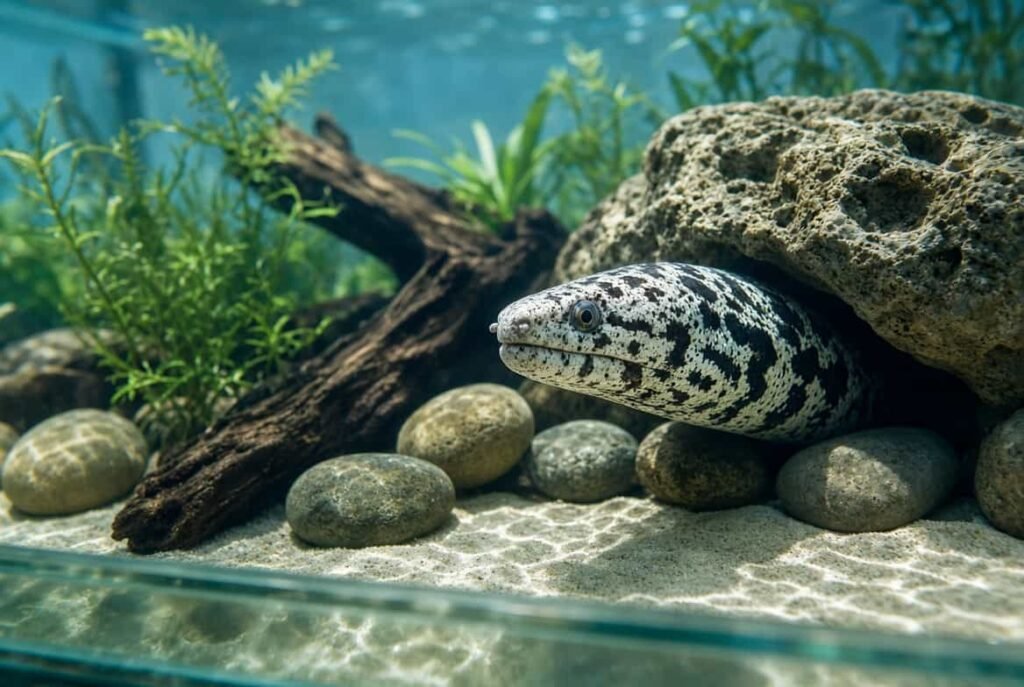
Eel fish have become increasingly popular in the aquarium hobby, but they are not a beginner friendly addition for every species. Success depends heavily on choosing the right type and preparing a tank that matches their natural burrowing, hiding, and escaping tendencies.
Tank size and setup: Most aquarium eel species need more room than their body length suggests, since they are active swimmers that also require hiding spaces. A general guideline is at least 30 gallons for smaller species like the snowflake eel, scaling up to 100 gallons or more for larger morays. A tightly fitted lid is essential; eels are notorious escape artists capable of squeezing through surprisingly small gaps.
Freshwater vs saltwater setup: True freshwater eels, along with species marketed as eel fish tank additions in the freshwater hobby, need stable water parameters similar to other freshwater community fish. Saltwater and reef focused species, such as snowflake and ribbon eels, require a fully cycled marine tank with consistent salinity and temperature.
Tank mates and eel goby fish compatibility: Eels generally do best with larger, non aggressive tank mates that will not be seen as prey. Smaller fish are at risk of being eaten, since eels are natural predators. Gobies are frequently kept alongside certain eel species in reef tanks, and some aquarists specifically pair eel and goby species for a more naturalistic, complementary dynamic, though compatibility should always be confirmed for the specific species involved.
Care level by species: Snowflake eels are considered relatively easy for intermediate keepers. Ribbon eels and garden eels fall into an expert only category due to specialized feeding requirements and sensitivity to water changes. Freshwater eel fish tank setups tend to be more forgiving for beginners than their marine counterparts.
Feeding follows the same nocturnal pattern eels show in the wild, so offering food in the evening, using small fish, shrimp, or appropriately sized pellets, tends to produce better results than daytime feeding attempts.
Eel fish rewards the right cooking method with a rich, buttery texture that few other seafood options can match. Its firm flesh and higher fat content, compared to leaner white fish, make it especially well suited to techniques that use direct heat or bold marinades.
Grilling: The most popular method worldwide, especially for Japanese style preparations. Brush fillets with oil or marinade, then grill over medium heat for 4 to 6 minutes per side, basting periodically to build flavor and prevent drying out.
Kabayaki style (grilled with sweet soy glaze): This is the technique behind traditional unagi sushi. Eel fillets are butterflied, grilled, then repeatedly basted with a sweet and savory sauce made from soy sauce, mirin, and sugar until the glaze caramelizes into a glossy coating. Served over steamed rice, this remains the most recognizable eel dish globally.
Frying: Cut eel into smaller, evenly sized pieces before frying to ensure consistent cooking. Medium high heat works best, frying until golden brown, then serving with dipping sauces or fresh herbs to balance the richness.
Baking: A gentler option for home cooks. Preheat the oven to 180°C (350°F), season with garlic, herbs, and lemon, then bake for 15 to 20 minutes until the flesh is tender and fully cooked through.
Smoking: Common in European preparations, particularly with European eel. Smoking intensifies the natural richness of the meat and produces a firmer texture, often served cold as an appetizer.
Because eel absorbs marinades and sauces exceptionally well, it holds up to sweet, smoky, and spicy flavor profiles better than most delicate white fish, which is part of why it remains a standout choice across such different cuisines, from Japanese kabayaki to European smoked eel to Southeast Asian curries.
Despite their popularity in cuisine and the aquarium trade, several major eel species face serious population declines, and this is an important trust and awareness point for anyone learning about eel fish.
Current IUCN status:
These declines matter beyond conservation circles, since freshwater eels cannot currently be bred in captivity. Every farmed eel, including most unagi served in restaurants worldwide, ultimately traces back to a wild caught glass eel or elver, which places direct pressure on already struggling wild populations.
Several factors are driving this decline:
Organizations including the World Wildlife Fund and regional agencies like the Susquehanna River Basin Commission have active eel restoration and tracking programs, including dam bypass systems and juvenile eel tagging efforts, aimed at helping populations recover. Choosing eel from traceable, sustainably managed sources, such as land based aquaculture operations that avoid illegally sourced glass eels, is one practical way consumers can reduce pressure on wild populations
So, is eel a fish? Yes, without question. Despite its snake like body, scaleless skin, and reputation for confusion, eel fish is a true fish, classified under order Anguilliformes, breathing through gills, and sharing core biology with every other fish species in the water.
This guide covered far more than that single question. You now know how eel fish differs from snakes and amphibians, why the electric eel is not a true eel at all, the six dramatic life stages every freshwater eel goes through, and what makes species like moray, conger, and rope eels so distinct from one another. You also have practical answers on safety, nutrition, pricing, regional naming across India, and what it actually takes to keep eel fish successfully in a home aquarium.
Eel fish sits at a genuinely interesting intersection of biology, cuisine, and conservation, and that combination is exactly why it continues to generate so much curiosity. As search behavior increasingly shifts toward direct, well sourced answers rather than generic overviews, content that treats eel fish with this level of depth is positioned to remain useful for readers and AI search platforms alike well into 2026 and beyond.
Is eel a fish or a snake?
Eel is a true fish, not a snake. It belongs to the order Anguilliformes, breathes through gills, and has a backbone like any other fish. Its snake like shape comes from having no pelvic fins and scaleless skin, but biologically it shares nothing with snakes, which breathe air through lungs.
Is an eel a fish or an amphibian?
Eel is a fish, not an amphibian. Amphibians like frogs need both water and land to complete their life cycle, switching between gill and lung breathing. Eels remain fully aquatic throughout their lives, breathing only through gills, even during brief overland movement across wet surfaces.
Is electric eel actually a true eel?
No, the electric eel is not a true eel. It belongs to the order Gymnotiformes, the knifefish family, making it more closely related to catfish than to true eels in order Anguilliformes. It only earned the name “eel” because of its long, cylindrical body shape.
Are eel fish dangerous to humans?
Most eel species are not dangerous. Electric eels can deliver shocks up to 600 volts, posing risk near water, and moray eels can bite if provoked or handled. True freshwater eels like European or American eel pose minimal danger under normal circumstances.
What do eel fish eat in the wild?
Eel fish are carnivorous, feeding on small fish, crustaceans, insects, worms, and mollusks. Their diet shifts with age, starting with smaller invertebrates as juveniles and expanding to include fish as they grow. Most species hunt at night using smell rather than eyesight.
How long do eel fish live?
Freshwater eels can live 15 to 20 years on average, with some individuals surviving 40 years or longer in the wild. Lifespan varies by species and environment, with yellow eels spending years in freshwater before their final transformation into ocean bound silver eels.
Can you keep eel fish in a home aquarium?
Yes, several eel species, including snowflake eels and certain freshwater types, adapt well to home aquariums. Success depends on tank size, a secure lid to prevent escapes, appropriate tank mates, and species specific care requirements, since some eels need expert level care.
Is eel fish healthy to eat?
Yes, eel fish is nutrient dense, offering 18 to 20 grams of protein per 100 grams, along with omega 3 fatty acids, vitamin B12, vitamin A, vitamin D, selenium, and phosphorus. It supports heart, brain, and bone health as part of a balanced diet.
Are eel fish endangered?
Several major species face serious decline. The European eel is Critically Endangered, while American and Japanese eels are listed as Endangered. Habitat fragmentation, pollution, climate change, and overfishing of juvenile glass eels are the primary threats driving these population losses.
What is eel fish called in different Indian languages?
Eel fish is called Vilangu in Tamil, Pambu Meen in Malayalam, Vam in Marathi, Baam Machhli in Hindi, and Baam Maach in Bengali. Naming can vary slightly by region and local dialect across India’s coastal and river communities.

Fish Info Guide helps you explore edible, freshwater, saltwater, and aquarium fish – with simple guides on nutrition, care, and species identification for beginners and enthusiasts alike.
Imortant Links
Quick Links
Subscribe Our Newsletter
Get the latest fish care tips, species guides, and nutrition insights delivered straight to your inbox.