

You have probably stood at the edge of a body of water and wondered what to call it. Most people guess based on size, and most people guess wrong.
Here is the direct answer: the main pond vs lake differences come down to depth and sunlight, not surface area. If sunlight reaches the bottom across the entire water body, allowing plants to root anywhere, it is a pond. If part of it is deep enough that sunlight never reaches the bottom, it is a lake.
That single test explains why Walden Pond covers 61 acres while some water bodies under an acre are properly called lakes.
This guide covers the science, the size rules used in the US and UK, the wildlife each supports, and a simple six step field check you can run yourself. By the end, you will be able to classify almost any body of standing water with confidence, and know exactly why the labels on the map so often disagree.
If you only read one section, read this one. The table below summarises every meaningful pond vs lake difference that limnologists actually use, ranked from most reliable to least.
Short answer: a pond is shallow enough that sunlight reaches the bottom everywhere, keeps a fairly uniform temperature, and supports rooted plants across its whole floor. A lake has at least one area too deep for sunlight to reach bottom, separates into temperature layers in summer, and confines rooted plants to its margins.
Feature | Pond | Lake |
Sunlight reaches bottom | Yes, across the whole area | No, at least part is dark |
Light zones present | Photic zone only | Photic and aphotic zones |
Typical depth | Usually under 15 feet (4.5 m) | Often well over 15 feet |
Summer temperature | Fairly uniform top to bottom | Layered, with a thermocline |
Rooted plants | Can grow anywhere on the bed | Restricted to shallow edges |
Wave height | Small, rarely over a few inches | Can exceed 12 inches routinely |
Surface area | Usually small, but not always | Usually large, but not always |
Typical fish | Bass, bluegill, carp, roach, tench | Trout, walleye, pike, perch, char |
Legal status | Same as a lake in most jurisdictions | Same as a pond in most jurisdictions |
Notice the last row. Regulators in most US states treat both as surface waters subject to identical water quality standards, so the name on the sign carries no legal weight.
A pond is a small, still, inland body of water, natural or human made, that is shallow enough for sunlight to reach the bottom across its entire area. That light penetration is the defining trait. Everything else, including size, follows from it.
Because the whole floor sits in the lit zone, a pond behaves as one continuous habitat. Rooted plants can establish anywhere. Water temperature stays broadly uniform from surface to bed. Wind mixes the column easily, so oxygen and nutrients circulate rather than settling into separate layers.
Typical pond characteristics:
Limnologists, the scientists who study inland waters, classify by the photic zone. If the photic zone covers 100 percent of the bed, the water body is a pond. This is why a two acre farm pond and a 300 acre shallow southern water body can both be ponds while a deep quarry pit of half an acre is not.
The UK uses a size based rule instead. Freshwater Habitats Trust, adopted by WWT and The Wildlife Trusts, defines a pond as a water body between 1 square metre and 2 hectares (about 4.9 acres, or roughly two and a half football pitches) that holds water for four months of the year or more. Anything larger is treated as a lake. Ponds under this definition support two thirds of all UK freshwater species.
A lake is a large, still, inland body of water with at least one area deep enough that sunlight never reaches the bottom. That dark zone, called the aphotic zone, is what separates a lake from a pond. A lake can still have shallow, sunlit edges, but somewhere in its basin the water is too deep for light to penetrate.
That depth changes everything about how a lake behaves. It stratifies in summer, holds larger waves, and supports fish and plant communities that pond ecosystems cannot sustain.
Typical lake characteristics:
Lakes form through several distinct geological processes, and knowing the type often explains a lake’s depth and shape.
The UK’s Lake District and Scotland’s lochs are almost entirely glacial in origin, carved during the last ice age and later filled as the ice retreated.
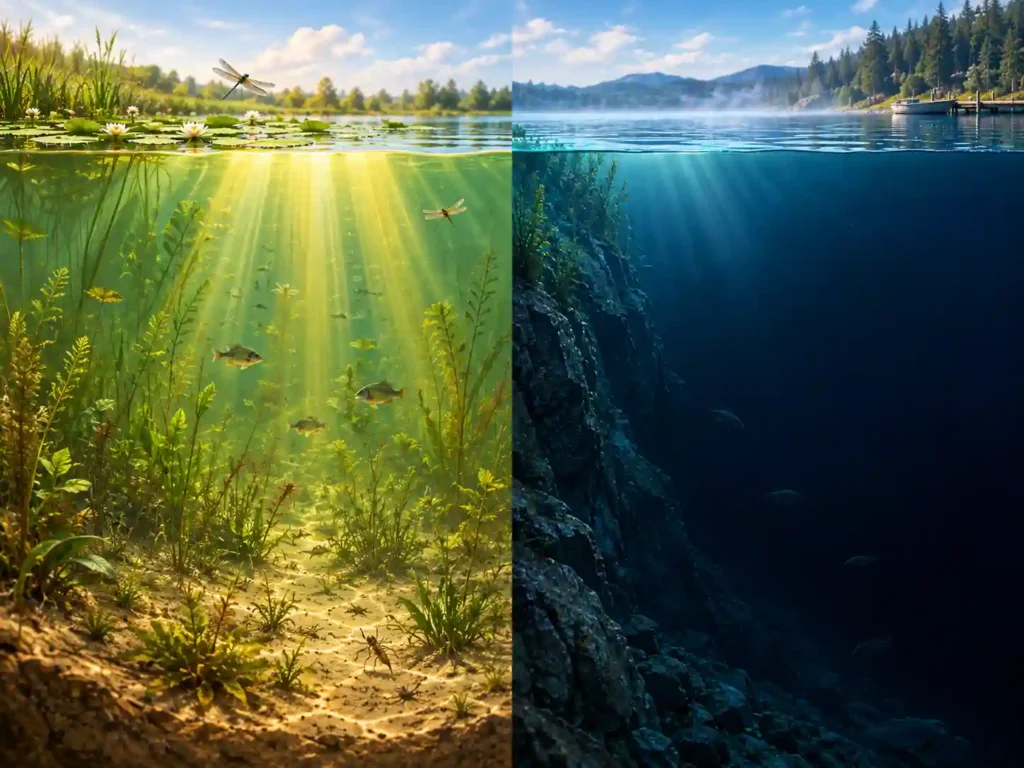
Here is the myth this article exists to correct: size does not determine whether a body of water is a pond or a lake. Depth and light penetration do.
Almost every other source you will find online leads with size, then quietly contradicts itself a paragraph later. We are not going to do that.
The technical term is the photic zone, the depth range where sunlight penetrates strongly enough to support plant growth. In a pond, the photic zone reaches the entire bed. There is no point in the water column too dark for a rooted plant to grow. In a lake, part of the basin sits below that light threshold. That deeper, dark section is the aphotic zone, and it changes the biology completely.
Why this matters more than surface area:
The aphotic zone is not just a technicality. Without light, rooted plants and algae cannot photosynthesize there, so that layer is populated only by organisms that survive on falling organic matter and each other, mostly zooplankton, bottom feeding fish and decomposers. That is a fundamentally different food web from a pond, where light supports growth from surface to floor everywhere.
Direct answer for quick reference: use depth and light, not size, whenever you need the technically correct classification. Use local size thresholds only when you need the legal or regulatory classification, since those are separate systems that do not always agree with the science.
Even though scientists use depth and light, plenty of real world rules still use size, because a tape measure is easier to apply than a light meter. The catch is that these thresholds vary by state and by country, and none of them agree with each other.
Direct answer: no single size threshold applies everywhere. US states typically draw the line between 10 and 20 acres, the UK draws it at 2 hectares (about 4.9 acres), and international wetland treaties allow ponds up to 8 hectares. Always check the local definition before assuming a number.
Here is how the major thresholds compare:
The gap between these numbers is exactly why the same size water body can be officially a pond in one country and a lake in another. When you see a number quoted for “how big is a lake,” check which body issued it before treating it as universal.
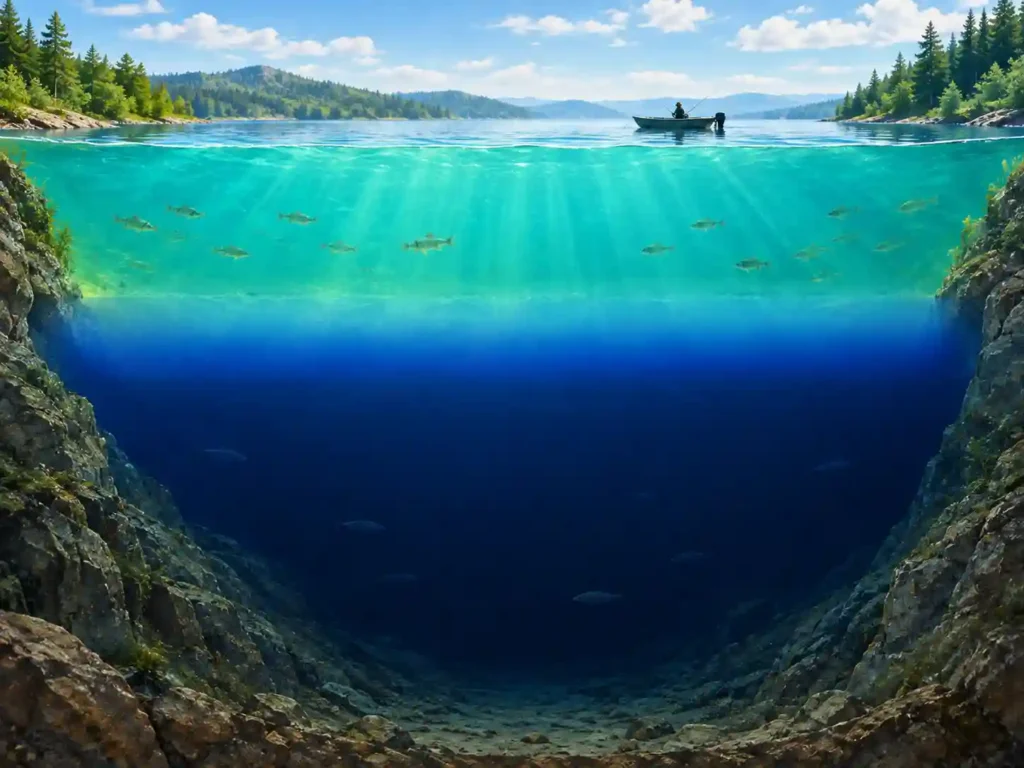
Direct answer: a lake typically separates into distinct temperature layers each summer, called stratification, while a pond stays close to one uniform temperature top to bottom. This layering, more than depth alone, is the test some limnologists use to draw the line.
Here is how it works. As summer sun warms a lake’s surface, that warm water becomes less dense and floats on top of the colder water below. Wind can mix the surface layer but usually cannot push all the way to the bottom in a lake deep enough to hold an aphotic zone. Three layers form:
A pond, by contrast, is shallow enough that wind and convection mix the entire column regularly. Water temperature stays within a few degrees from surface to bed. There is rarely enough depth for a stable thermocline to form and persist.
Lakes that stratify twice a year, once in summer and once in winter, with the layers mixing completely each spring and autumn, are called dimictic lakes, the most common pattern across temperate regions of the US and UK. During spring and autumn turnover, surface and bottom water temperatures equalize, the layers mix, and oxygen gets redistributed through the whole lake, which is often when fish activity noticeably changes.
Practical note: if you own or manage a pond and it suddenly behaves like it has layers, with a cold, low oxygen bottom in summer, that is usually a sign it is deeper or larger than a typical pond, or that stratification is becoming a management problem worth addressing with aeration.
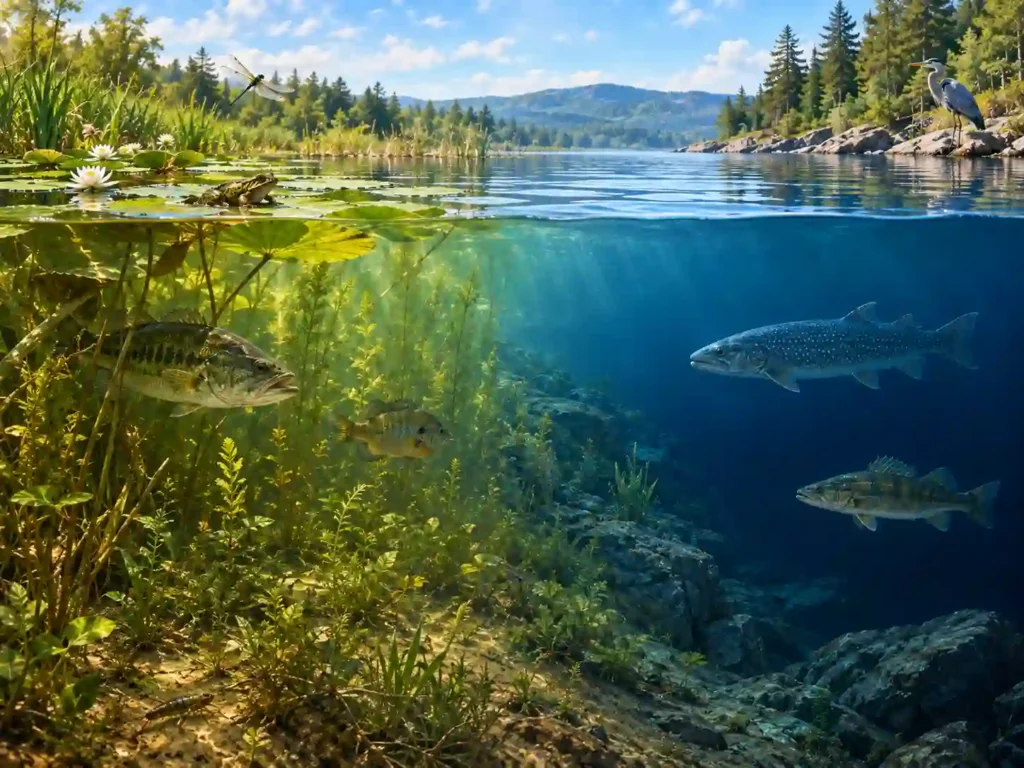
Direct answer: ponds support life across their entire volume because light and oxygen reach everywhere, while lakes support a wider range of specialised species because their layered structure creates distinct habitats at different depths.
In a pond, rooted plants and algae can establish anywhere on the bed, since the whole floor sits in the photic zone. This produces dense, often visible plant cover: pondweed, water lilies, duckweed and algae can spread across the entire surface if nutrients are abundant. In a lake, rooted plants are confined to the shallow littoral zone near shore. The open water and depths beyond that band stay largely free of rooted vegetation, though phytoplankton still drifts through the sunlit surface layer.
Fish species you find in each
Ponds tend to favour warmwater, oxygen tolerant species that thrive in shallow, uniformly warm water:
Lakes, especially deeper glacial lakes, can support coldwater species that need the cold, oxygen rich hypolimnion or well mixed open water:
A lake’s layered structure lets warmwater and coldwater species coexist at different depths, something a shallow pond simply cannot offer. If you are deciding what to stock or target based on these species differences, our fish species and care guides at FishInfoGuide cover pond and lake fish in more depth.
Amphibians, invertebrates and birds
Ponds are disproportionately important for amphibians and invertebrates relative to their size. Common frogs, common toads, great crested newts, diving beetles and damselflies rely heavily on small, warm, plant rich ponds for breeding. Freshwater Habitats Trust research shows ponds support roughly two thirds of all UK freshwater species despite covering a tiny fraction of total freshwater surface area.
Lakes support larger waterfowl populations and species that need open water for feeding or resting, such as diving ducks and geese, alongside fish dependent birds like herons and ospreys that hunt the shallower littoral margins.
Direct answer: ponds are more vulnerable to water quality problems than lakes because their small volume relative to surface area means nutrients, heat, and pollutants concentrate faster, with far less water to dilute them.
A lake’s sheer volume gives it a buffer. Nutrients entering a large lake get diluted across millions of gallons, and the cold hypolimnion acts as a reservoir of oxygen rich water that mixes back in during turnover. A pond has none of that cushioning. The same load of fertilizer runoff or leaf litter has a much bigger relative impact.
Common pond specific problems:
Lakes are not immune to any of these, but their scale usually slows the process down and gives managers more time to react. This is one practical reason many pond owners install aeration systems: keeping the water column mixed prevents the low oxygen conditions that trigger fish kills and algae blooms in the first place.
Direct answer: lakes generate larger waves and more shoreline erosion than ponds because wave height depends on fetch, the open distance wind travels across water, and lakes simply offer more room for wind to build momentum.
Fetch is the key concept here. The longer the uninterrupted stretch of open water, the more energy wind can transfer into waves before they reach shore. A small pond, even in a strong wind, rarely produces waves over a few inches because there is not enough distance for the wind to build them up. A lake with a mile or more of open water can easily produce waves exceeding 12 inches, and large lakes like the Great Lakes generate waves comparable to ocean swells during storms.
This difference in wave energy shapes the shoreline itself:
Currents differ too. Ponds are largely current free unless fed by an inlet stream. Lakes can develop wind driven surface currents and, in larger examples, even measurable rotational currents influenced by the Coriolis effect, though that is only significant in genuinely large lakes.
Direct answer: many water bodies are named “pond” or “lake” based on history and local custom rather than science, which is why some ponds are larger than some lakes and the names on a map often contradict the technical definition.
Walden Pond in Concord, Massachusetts, is the clearest example. It covers about 61 acres and reaches roughly 30 metres (100 feet) at its deepest point, technically deep enough to develop an aphotic zone and qualify as a lake by the limnological definition. Henry David Thoreau made it famous through his book about living beside it, and the name pond stuck permanently, regardless of what science would call it. Nearby Spot Pond covers around 340 acres, larger than many named lakes across New England, yet keeps its historical name too.
New England has a strong regional habit of calling almost any freestanding inland water a pond, no matter the size, a naming convention rooted in early colonial land surveying rather than any scientific standard.
The reverse also happens. New Hampshire has documented several ponds renamed to lakes purely for marketing reasons, to make the surrounding area sound more appealing to prospective home buyers:
None of these renamings changed the water body’s depth, ecology, or legal status. They changed only the label, which is exactly why relying on a name to determine pond vs lake differences will mislead you more often than it helps.
Direct answer: in most US states and in the UK, there is no separate legal category for “lake” versus “pond.” Both are regulated as the same type of surface water, though a handful of size based legal designations exist alongside the everyday names.
United States
From a regulatory standpoint, ponds and lakes are treated identically in most states. Both fall under the same surface water quality standards, meaning the same rules for pollution discharge, protected buffers, and water quality monitoring apply regardless of what the water body is called.
New Hampshire illustrates this well. State law draws no distinction between “lake” and “pond” at all. But a separate size trigger exists: any water body of 10 acres or more is legally classified as a “Great Pond,” a designation that brings it under state oversight and public access protections, no matter whether local custom calls it a lake or a pond. This means a small water body called a lake and a large one called a pond can both be Great Ponds under the same law.
United Kingdom
The UK approaches this differently, through conservation policy rather than water quality law. Ponds meeting the Freshwater Habitats Trust size definition, generally under 2 hectares, can be designated Priority Ponds, officially termed a Habitat of Principal Importance under the Natural Environment and Rural Communities (NERC) Act 2006. This status, overseen by Natural England and Defra, exists specifically to protect small waterbodies with high conservation value, recognising that ponds punch well above their size in supporting freshwater biodiversity.
Practical takeaway: if you are buying property with a water body on it, or planning any work near one, check your state or local authority’s specific rules rather than assuming its common name determines what regulations apply. The label on a map or deed carries essentially no legal weight on its own.
Direct answer: reservoirs, tarns, lochs, lagoons and swamps are all related but distinct types of water body, separated from ponds and lakes by how they formed, their salinity, or how much standing vegetation they contain.
Understanding these neighbouring terms sharpens your grasp of pond vs lake differences, since several of them get used loosely as synonyms when they technically are not.
Term | What actually makes it different |
Reservoir | An artificial lake created by damming a river, built specifically for water supply, hydropower, or flood control. Functionally a lake, but always human made and always tied to a dam |
Tarn | A small mountain lake formed in a bowl carved by a glacier, typically found at high altitude in places like the English Lake District |
Loch / Lough | Simply the Scottish and Irish words for lake, with no scientific difference implied. Loch Ness is a lake in every technical sense |
Lagoon | A shallow body of water separated from a larger sea or ocean by a sandbar, reef, or barrier island, often brackish rather than fresh |
Swamp | A forested wetland where trees and shrubs grow directly in standing or slow moving water, distinguished by woody vegetation rather than open water |
Marsh | A wetland dominated by grasses and reeds rather than trees, generally shallower and more vegetated than a pond |
Oxbow lake | A crescent shaped lake formed when a meandering river cuts off a loop and seals it from the main channel |
Vernal pool | A temporary pond that fills seasonally, often in spring, and dries out completely later in the year |
The pattern across all of these: formation and vegetation type, not size, usually drive the classification. A swamp with more open water than trees starts to resemble a marsh. A tarn that loses its glacial origin story is, functionally, just a small lake. None of these distinctions rely on a fixed acreage, which reinforces the same lesson from earlier in this article, names describe origin and character far more than they describe a strict measurement.
Direct answer: you can classify almost any water body yourself with six checks: measure maximum depth, check for a summer thermocline, survey plant growth across the bed, observe wave height, check local size thresholds, and check for a dark, light free zone. If two or more point to “lake,” treat it as one.
Practical shortcut: if you do not have access to a Secchi disc or thermometer, steps 3 and 5 alone, plant coverage and wave height, will get you the right answer in the vast majority of everyday cases.
Direct answer: whether your water body is technically a pond or a lake affects stocking choices, management costs, permit requirements, and even property value, so it is worth knowing which category you actually fall into rather than relying on the name.
If you are stocking fish
A shallow pond that never develops a thermocline needs oxygen tolerant species that can handle warm summer water and potential winterkill risk, largemouth bass, bluegill and carp are common choices for this reason. A deeper lake with a cold hypolimnion can support coldwater species like trout, but only if that bottom layer stays oxygen rich enough through summer stratification. Stocking a coldwater species into a pond that lacks a stable cold zone usually ends badly by midsummer.
If you are managing water quality
Ponds need closer, more frequent attention because their small volume concentrates problems fast. Aeration systems, buffer strips to reduce nutrient runoff, and regular algae monitoring matter more for a pond than for a large lake with more natural dilution capacity. Dredging, removing accumulated sediment to restore depth, is a common and often necessary maintenance task for aging ponds that are gradually filling in.
If you are buying property
A water body’s actual classification, not its name, can affect insurance requirements, liability exposure, and whether public access rights apply. In areas with a Great Pond style law, even a small “lake” might carry public access obligations if it crosses the acreage threshold. Always check the specific classification with your local authority rather than assuming the name on the listing settles the matter.
If you need permits
Dredging, building a dock, or modifying a shoreline typically requires a permit regardless of whether the water body is called a pond or a lake, since most regulatory frameworks classify by function and size rather than by name.
Direct answer: the most persistent myths about pond vs lake differences all center on size, but depth, light penetration, and naming history explain the real classification far better than acreage ever does.
Myth 1: A lake is always bigger than a pond. Fact: Spot Pond covers 340 acres, larger than many named lakes, while some deep quarry pits under an acre technically qualify as lakes. Size correlates with the pond and lake distinction on average, but it does not determine it.
Myth 2: Ponds are always man made. Fact: many ponds form naturally, through meandering rivers cutting off pools, glaciers retreating and leaving depressions, trees falling and exposing root pits, or even beavers damming a stream. Human made ponds are common, but nature builds plenty on its own.
Myth 3: There is a single legal definition everyone uses. Fact: definitions vary by state, by country, and even by which scientific body you ask. Illinois uses 20 acres, the UK uses 2 hectares, and the Ramsar Convention allows ponds up to 8 hectares. No universal legal standard exists.
Myth 4: Lakes always have better water quality than ponds. Fact: lakes are more resistant to sudden water quality swings because of their larger volume, but a poorly managed lake with heavy nutrient runoff can develop the same algae blooms and oxygen crashes as a poorly managed pond. Size buys resilience, not immunity.
Myth 5: If it is called a lake, it must be a lake, and vice versa. Fact: naming is driven by history, custom, and sometimes marketing far more than by science. Mud Pond became Mirror Lake for exactly this reason, with no change to the water body itself.
Understanding pond vs lake differences comes down to one core idea: depth and sunlight decide the classification, not surface area. A pond stays shallow enough for light to reach every part of its bed, while a lake holds at least one dark, deep zone that changes its temperature layers, plant life, and fish species. Size rules, naming customs, and legal definitions all vary by state and country, which is exactly why the label on a map so often contradicts the science underneath it.
Next time you stand at the edge of a body of water, run through the six step field check from this guide rather than guessing from size or name alone. As mapping tools and environmental data become more accessible through 2026, classifying the water bodies around you, correctly, and for the right reasons, has never been easier. For more guides on fish species suited to ponds versus lakes, visit FishInfoGuide.
What is the main difference between a pond and a lake?
The main difference is depth and light, not size. A pond is shallow enough for sunlight to reach the bottom everywhere, supporting plant growth across the whole bed. A lake has at least one area too deep for light to penetrate, called an aphotic zone, which changes its temperature layering and ecosystem.
How big does a pond have to be to become a lake?
There is no single answer. Illinois uses 20 acres, the UK’s Freshwater Habitats Trust uses 2 hectares (about 4.9 acres), and the Ramsar Convention allows ponds up to 8 hectares. Size thresholds vary by state and country, so check your local definition.
Can a pond be bigger than a lake?
Yes. Spot Pond in Massachusetts covers 340 acres, larger than many named lakes. Size does not determine the classification; depth and light penetration do, which is why naming often defies expectations.
Is a lake always deeper than a pond?
Generally yes, since depth creating an aphotic zone is the technical dividing line. But exceptions exist, some small pits deeper than 15 feet qualify as lakes despite covering less than an acre.
Are all ponds man made?
No. Many form naturally through river meanders, glacial retreat, fallen trees exposing root pits, or beaver dams. Human made ponds, dug for farms, gardens, or fishing, are common but not the only type.
Why is Walden Pond called a pond if it is 61 acres?
Historical naming convention. New England commonly calls freestanding inland water bodies ponds regardless of size, a habit rooted in early colonial surveying rather than science. Walden Pond’s depth technically qualifies it as a lake by the scientific definition.
Is there a legal difference between a lake and a pond?
In most US states and the UK, no. Both are regulated as the same category of surface water under identical water quality standards. Some places use separate size based legal terms, like New Hampshire’s “Great Pond,” that ignore the common name entirely.
What is the difference between a pond and a reservoir?
A reservoir is a type of artificial lake created specifically by damming a river for water supply, hydropower, or flood control. Functionally it behaves like a lake; the key difference is that it is always human made and always tied to a dam.
Do ponds and lakes have different fish?
Often, yes. Ponds favour warmwater, oxygen tolerant species like bass, bluegill and carp. Deeper lakes can support coldwater species like trout and walleye in their cold hypolimnion, alongside warmwater species near the surface.
What is the difference between a pond and a wetland or swamp?
A swamp is a forested wetland where trees and shrubs grow directly in the water, distinguished by woody vegetation. A pond is defined by open standing water with sunlight reaching the bottom throughout, with far less woody plant cover than a swamp.

Fish Info Guide helps you explore edible, freshwater, saltwater, and aquarium fish – with simple guides on nutrition, care, and species identification for beginners and enthusiasts alike.
Imortant Links
Quick Links
Subscribe Our Newsletter
Get the latest fish care tips, species guides, and nutrition insights delivered straight to your inbox.