

Your tetras look perfect in the shop. At home, they shred each other’s fins and eat your plants. That is the Buenos Aires tetra problem, and it catches many beginners out.
The Buenos Aires tetra (Hyphessobrycon anisitsi) is a hardy, silver bodied fish with red fins. It grows larger and rowdier than a neon or cardinal tetra. The short answer: it needs a tank of at least 30 gallons (about 115 litres), a school of six or more, sturdy tank mates, and tough plants. Get those four things right and it lives five to seven years with very little fuss.
This guide covers tank setup, water parameters, feeding, compatibility, and breeding. It also compares the species with cardinal, rummy nose, bloodfin, glow, and bucktooth tetras. It is written for US and UK fishkeepers who want the facts before they buy.
The Buenos Aires tetra (Hyphessobrycon anisitsi) is a freshwater characin from South America. It belongs to the family Characidae, the same broad group as neon, cardinal, and rummy nose tetras. Some newer references list it as Psalidodon anisitsi, so you may see both names on care sheets and shop labels. They describe the same fish.
Quick answer: The Buenos Aires tetra is a hardy, active tetra fish species native to the Paraná and Paraguay river basins, across Argentina, Paraguay, and southern Brazil. It tolerates a wide range of water conditions, which is why it has been a staple of the aquarium trade for so long.
In the wild, these fish shoal in rivers, streams, and vegetated shallows. They are omnivores that pick at insects, small crustaceans, and plant matter. That varied diet explains their habit of nibbling aquarium plants later on.
Hobbyists love the species for its silver body, red fins, and the black diamond mark at the base of the tail. It is also larger and pushier than most small tetras, and that shapes everything from tank size to tank mates. The next sections cover each of those choices in detail.
Quick answer: An adult Buenos Aires tetra reaches about 2.75 to 3 inches (7 to 8 cm) and lives 5 to 7 years with good care. That makes it one of the larger and longer lived tetras you can keep in a community tank.
The body is deep, laterally flattened, and metallic silver, often with a faint blue or green sheen under aquarium lights. The red fins are the standout feature, along with the black diamond shaped mark at the base of the tail. Males usually show stronger red colour, especially when they are ready to spawn. Females tend to look fuller and slightly rounder.
Here are the key facts at a glance:
You may also find colour variants in shops. The albino form has a pale body, red eyes, and red fins, but it tends to be less robust than the standard fish. Some stock shows yellowish patches near the tail. Both variants share the same care needs and the same boisterous behaviour.
Quick answer: Yes, with two conditions. The Buenos Aires tetra is one of the easiest tetras to keep because it tolerates a wide range of temperature, pH, and hardness. But it needs a big enough tank and the right tank mates, or it becomes nippy and destructive.
Most beginner mistakes with tetras come from fragile species that crash in unstable water. This fish is the opposite. It forgives small errors while you learn about the nitrogen cycle, water changes, and filtration. It also eats almost anything, and it is active enough to be fun to watch.
Why it suits beginners:
What catches beginners out:
If you want a peaceful nano community with delicate plants, pick a smaller species such as a cardinal tetra instead. If you want an energetic, tough fish for a larger tank, this is a strong choice.

Quick answer: A group of six to eight Buenos Aires tetras needs a tank of at least 30 gallons (about 115 litres). Choose a long tank, ideally 36 inches (90 cm) or more, rather than a tall one. These fish swim fast and constantly, so horizontal space matters more than volume alone.
Some sources say 20 gallons is enough. It can work for a small group, but a cramped tank increases nipping and makes water quality harder to control. If you plan a community tank, add the needs of the other fish on top of this baseline.
Setup checklist:
Cycle the tank fully before adding fish. Ammonia and nitrite should read zero, with some nitrate showing. Add the school together rather than one at a time, so the group settles as a unit.
Quick answer: Aim for 72 to 79°F (22 to 26°C), a pH of 6.0 to 8.0, and moderate hardness of 5 to 20 dGH. The Buenos Aires tetra tolerates much wider swings than most tetras, but a stable tank still keeps it healthier and better coloured.
Ideal water parameters:
Sources quote a wider survival range of roughly 64 to 82°F (18 to 28°C). That tolerance is real, and it is why some keepers run these fish in unheated or cooler tanks. Treat it as a safety margin, not a target. Consistent water suits them better than water that drifts.
Do you need a heater? In a heated home, often not. In a cool room, especially in the UK winter, a small adjustable heater keeps the temperature steady and prevents stress related illness.
Test with a liquid kit weekly, especially in the first two months. Sudden changes cause more trouble than a slightly off number. Match the temperature and pH of new water to the tank before every water change.
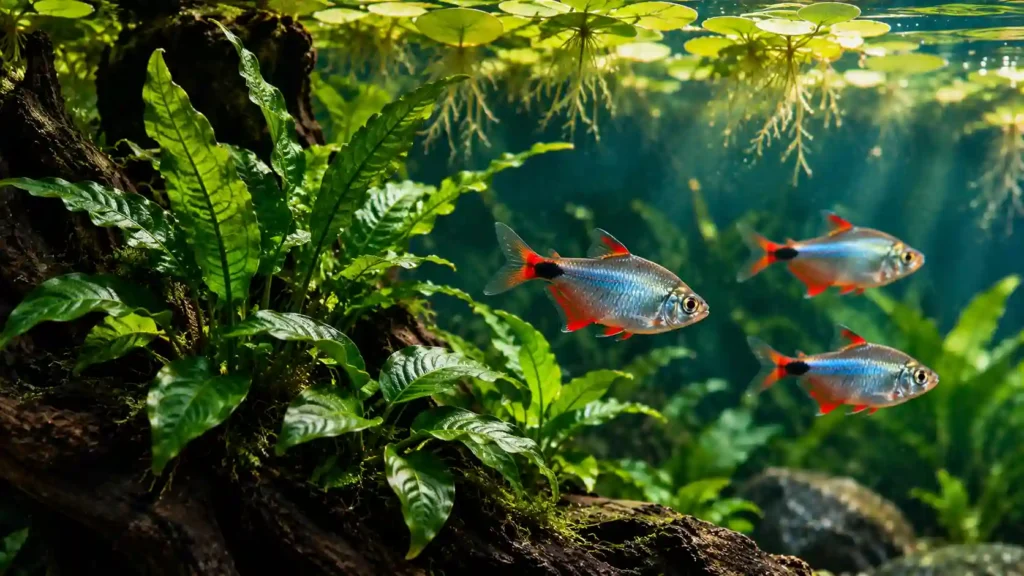
Quick answer: Yes, Buenos Aires tetras eat plants. They shred soft, fine leaved species like cabomba, hygrophila, and many stem plants, sometimes overnight. Tough plants such as Java fern, anubias, and bolbitis usually survive.
This behaviour comes from their omnivore diet in the wild, where plant matter is part of the menu. Feeding them vegetables and quality flakes helps, but it will not stop the habit completely. Choose your plants with that in mind.
Plants that usually survive:
Fast growing floaters that can outpace the damage:
Attach Java fern and anubias to driftwood or rock instead of burying them, since these plants have rhizomes that rot in substrate. Floaters also soften the lighting, which many tetras appreciate.
You can also skip live plants and build a hardscape tank. Smooth rocks, driftwood, and a few silk plants give the fish cover without any maintenance. Leave plenty of open space in the middle for swimming.
Tip: Add blanched spinach or zucchini once or twice a week. It gives the school something green to eat other than your plants.
Quick answer: Buenos Aires tetras are omnivores that eat almost anything. Feed a quality flake or micro pellet as the daily staple, then add frozen or live foods a few times a week and some blanched vegetables for balance.
In the wild they eat small insects, crustaceans, and plant matter. Copying that variety in your tank improves colour, energy, and long term health.
A balanced menu:
Feed small amounts once or twice a day, only as much as the school finishes in about two minutes. Overfeeding fouls the water and raises nitrate levels quickly. Skip one day a week to give their digestion a rest.
Watch the pecking order at feeding time. Fast, pushy fish can steal food from slower tank mates, so spread the food across the surface and mid water. If you keep bottom dwellers such as Corydoras, drop in a sinking wafer after the tetras have eaten.
Tip: Rotate foods rather than feeding the same one every day. Variety reduces the chance of nutritional gaps and keeps the fish interested.
Quick answer: The Buenos Aires tetra is best described as boisterous and semi aggressive. It is a fast, active schooling fish that nips the fins of slower tank mates, especially when kept in a group smaller than six or when it is bored.
Nipping is not random meanness. In a proper school, the fish spend most of their energy chasing each other and sorting out a pecking order. In a group of two or three, that attention lands on the nearest tank mate instead.
What triggers fin nipping:
Their behaviour is easy to read. A healthy school swims in the mid water, often in loose formation. Fish that hide, clamp their fins, or dart at one tank mate are signalling stress or a mismatch.
Males can also squabble with each other, particularly at breeding time. This is usually harmless chasing, but watch for one fish being singled out.
Tip: Keep eight or more if your tank allows it. A larger school spreads out the energy, and the fish look far more natural.
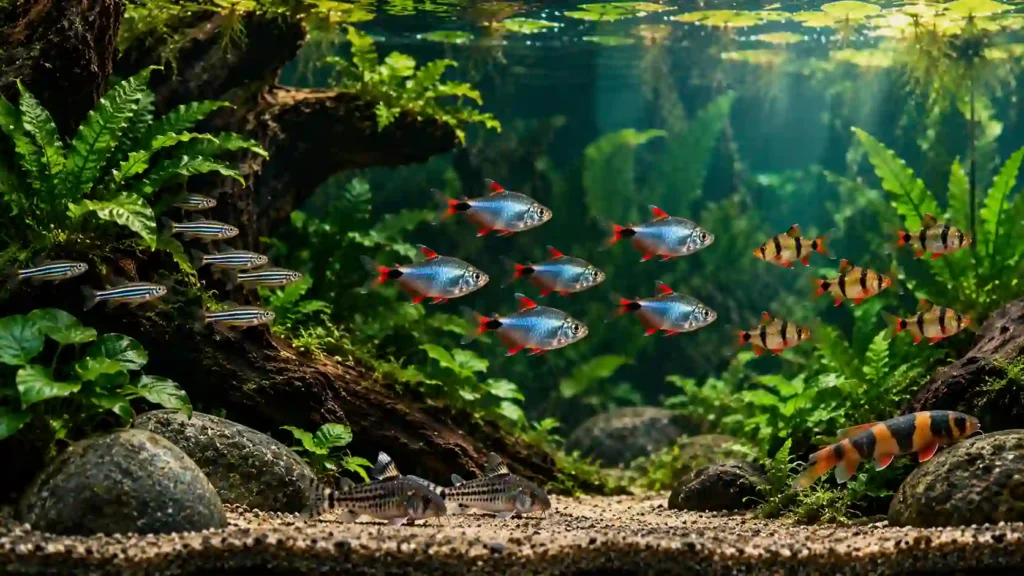
Quick answer: The best tank mates for Buenos Aires tetras are fast, sturdy fish of similar size, such as tiger barbs, zebra danios, larger rainbowfish, Corydoras, and loaches. Avoid slow, long finned, or tiny fish, because the tetras will nip or harass them.
Good tank mates can hold their own and share the same wide water tolerance. Fish that swim quickly are less likely to become targets.
Good tank mates:
Fish to avoid:
Stocking matters as much as species choice. A school of eight or more Buenos Aires tetras will keep most of its attention on itself. A tank with too few tetras and delicate neighbours is where problems start.
Tip: Add the tetras last or rearrange the décor before introducing new fish. This disrupts territories and reduces early squabbles.
Quick answer: The Buenos Aires tetra is larger, tougher, and rowdier than cardinal or neon tetras. Cardinals and neons are small, peaceful, and more sensitive to water quality. Do not keep them together, because the Buenos Aires tetra can bully and even eat the smaller fish.
“Neon cardinal tetras” is a search phrase that mixes two different fish. The cardinal tetra (Paracheirodon axelrodi) has a bright blue stripe with red running the full length of the body. The neon tetra (Paracheirodon innesi) has the same blue stripe but red only on the rear half. Both stay around 1.5 to 2 inches (4 to 5 cm).
How they compare with the Buenos Aires tetra:
Cardinals also do best in warmer, softer water, and many are still wild caught, which can make them harder for beginners. The Buenos Aires tetra tolerates far more.
Choose the Buenos Aires tetra if you want energy and durability. Choose cardinals or neons if you want a calm, colourful school in a planted tank with gentle tank mates.
Quick answer: Among common tetras, the bloodfin tetra is the closest match to the Buenos Aires tetra in hardiness and energy. Rummy nose and glowlight tetras are gentler and more sensitive, and the bucktooth tetra is a predator that does not belong in a normal community tank.
Buenos Aires Tetra vs Rummy Nose Tetra
The rummy nose tetra (Hemigrammus rhodostomus) is a tight schooling fish of about 2 inches (5 cm) with a bright red nose. It prefers warm, soft, slightly acidic water and is far less forgiving than the Buenos Aires tetra. The red nose fades when the fish are stressed, which makes it a handy health indicator. Keep them apart, because the Buenos Aires tetra will harass them.
Buenos Aires Tetra vs Bloodfin Tetra
The bloodfin tetra (Aphyocharax anisitsi) is a silver fish with red fins that grows to about 2 inches (5 cm). It comes from the same river basins and shares the species name anisitsi, which explains a lot of mix ups. It is hardy and active like the Buenos Aires tetra, though smaller and less destructive. In a large tank they can share space, but the bloodfin is still the smaller fish.
Buenos Aires Tetra vs Glow Tetra
“Glow tetra” can mean two different fish. The glowlight tetra (Hemigrammus erythrozonus) is a peaceful 1.5 inch fish with an orange stripe. GloFish tetras are fluorescent, genetically modified black skirt tetras (Gymnocorymbus ternetzi) with long, flowing fins. Both are tempting targets for a nippy Buenos Aires tetra, so avoid mixing them in small tanks.
Buenos Aires Tetra vs Bucktooth Tetra
The bucktooth tetra (Exodon paradoxus) grows to about 4 inches (10 cm) and eats scales and fin tissue from other fish. Keep it only with fast, robust species, and never with the delicate fish in your community tank.
Which should you choose?
Quick answer: Buenos Aires tetras are egg scatterers that breed readily in captivity. Condition a healthy pair or small group with protein rich food, move them to a dim breeding tank with fine leaved cover, and remove the adults after spawning, because they eat their own eggs.
Breeding is one of the easiest projects you can try with a tetra fish species, which is part of why the fish has stayed popular for decades.
Basic breeding setup:
Eggs hatch in roughly a day and a half. The fry become free swimming a few days later, and eggs and fry are sensitive to bright light, so keep the tank dim. Feed infusoria or a liquid fry food at first, then move to baby brine shrimp as they grow.
Quick answer: Buenos Aires tetras are hardy, but they can still get ich (white spot disease), fin rot, and stress related infections. Most problems trace back to poor water quality, sudden temperature swings, or new fish added without quarantine.
Catching trouble early makes treatment far easier. Watch the school at feeding time, because sick fish often skip meals or hang apart from the group.
Common problems and signs:
Because these fish tolerate cooler temperatures, avoid raising heat sharply without a heater and thermometer in place. Medication doses vary by product, so follow the label and keep a sick fish’s tank mates in mind.
Prevention:
If several fish die quickly or symptoms do not respond to treatment, consult an aquatic vet or your local fish store.
Quick answer: Change 25 to 30 percent of the water every week, test the water regularly, and rinse the filter media in old tank water once a month. A steady routine keeps nitrate low and helps prevent most health problems.
Buenos Aires tetras are active, hungry fish and produce a fair amount of waste, especially in a busy school. Regular maintenance matters more than any single product you buy.
Weekly routine:
Monthly routine:
Keep a simple log of test results. A slow rise in nitrate tells you it is time for larger or more frequent water changes before the fish show any sign of stress.
Tip: Never replace all your filter media at once. Swap in new media gradually so the bacteria that clear ammonia and nitrite stay in place.
Quick answer: Experienced keepers get the best results from Buenos Aires tetras by keeping a large school of ten or more, building a South American style tank, and matching them with equally robust fish. A bigger group spreads out nipping and shows the species at its best.
Quick answer: Buenos Aires tetras are widely available and inexpensive. Expect to pay roughly $3 to $6 each in the US and about £2.50 to £5 each in the UK, with prices varying by shop and size. Buy a school of six to eight at once, and quarantine them before adding them to your main tank.
Local fish stores are usually the best source, since you can watch the fish before buying. Chain pet shops such as Petco and PetSmart in the US, or Maidenhead Aquatics and independent aquatic centres in the UK, often stock them too. Online retailers can work well, but check reviews and their live arrival guarantee.
What to check before you buy:
Ask how long the fish have been in the shop. Fish that have been there for at least a week have usually settled and are less likely to be carrying a hidden illness.
Bring the fish home in a sealed bag, float it for 15 to 20 minutes, and acclimate them slowly to your water. Use a quarantine tank for two to four weeks if you can.
Tip: Buy from the same shop as your other fish where possible. That way you know their water conditions and stock quality.
The Buenos Aires tetra is a hardy, energetic fish that rewards the right setup. Give it a 30 gallon tank or larger, a school of six to eight, sturdy tank mates, and tough plants, and it can live five to seven years with very little fuss. Compared with cardinal, rummy nose, and glowlight tetras, it is tougher but also pushier, so choose it for a robust community tank rather than a delicate planted nano.
Your next step is simple. Measure your tank, list the fish you already keep, and check them against the tank mate guide above before you buy. Quarantine new fish and keep your water changes steady.
Looking ahead, fishkeeping searches in 2026 increasingly come from AI assistants and voice queries, so choose care sources that give clear, tested answers backed by real experience.
How big do Buenos Aires tetras get?
Buenos Aires tetras grow to about 2.75 to 3 inches (7 to 8 cm) as adults. That makes them larger than most popular tetras, such as neons and cardinals. They grow quickly and usually reach full size within their first year, so plan your tank for adult size rather than the size you see in the shop.
What size tank do Buenos Aires tetras need?
A school of six to eight needs at least a 30 gallon (115 litre) tank, ideally 36 inches (90 cm) long or more. These fish swim fast and constantly, so length matters more than height. A larger tank helps if you add tank mates, because each species needs its own space.
Are Buenos Aires tetras aggressive?
They are semi aggressive rather than truly aggressive. Buenos Aires tetras are boisterous and nip the fins of slow or long finned fish, especially in groups smaller than six. Keep a school of six or more and choose sturdy, fast tank mates such as barbs, danios, and Corydoras to keep the peace.
Do Buenos Aires tetras eat plants?
Yes, they eat soft, fine leaved plants such as cabomba and many stem plants, sometimes overnight. Tough plants like Java fern, anubias, and bolbitis usually survive. Fast growing floaters such as Amazon frogbit can also outgrow the damage. Feeding blanched vegetables may reduce plant nibbling.
How long do Buenos Aires tetras live?
With good care, Buenos Aires tetras live about 5 to 7 years, which is longer than most small tetras. Stable water, a varied diet, regular water changes, and a properly sized school all help. Poor water quality and stress are the most common reasons these fish die younger than expected.
What fish can live with Buenos Aires tetras?
Good tank mates are fast, sturdy fish of similar size, including tiger barbs, zebra danios, larger rainbowfish, Corydoras, loaches, and bristlenose plecos. Avoid bettas, fancy guppies, angelfish, and shrimp, because the tetras may nip or eat them. Delicate, slow, or long finned fish are the most likely to be harassed.
How many Buenos Aires tetras should be kept together?
Keep at least six, and eight or more is better. They are schooling fish, and a small group leads to stress and fin nipping toward other fish. In a 55 gallon tank or larger, a school of 10 to 15 spreads out energy and shows natural, confident behaviour.
Is a Buenos Aires tetra the same as a bloodfin tetra?
No. They are different species. The Buenos Aires tetra is Hyphessobrycon anisitsi, while the bloodfin tetra is Aphyocharax anisitsi. Both are silver with red fins and come from the same region, but the Buenos Aires tetra is larger at about 3 inches, and the bloodfin stays near 2 inches.

Fish Info Guide helps you explore edible, freshwater, saltwater, and aquarium fish – with simple guides on nutrition, care, and species identification for beginners and enthusiasts alike.
Imortant Links
Quick Links
Subscribe Our Newsletter
Get the latest fish care tips, species guides, and nutrition insights delivered straight to your inbox.