

Ever spotted a large, golden brown fish rooting through the mud at the bottom of a pond and wondered what it was? Chances are, you found a common carp. This hardy freshwater species is one of the most widely distributed fish on the planet, thriving everywhere from quiet farm ponds to major rivers across the United States, Europe, and Asia.
The common carp (Cyprinus carpio) is a large, deep bodied fish known for its distinctive barbels, large scales, and remarkable adaptability. It can grow past 30 pounds, live for decades, and survive in water conditions that would drive off most other fish species.
In this guide, you will learn how to identify a common carp, how it compares to grass carp and Asian carp, where it lives, what it eats, whether it is considered invasive, and how it is used both in sport fishing and as a food source. Whether you are trying to identify a fish you just caught or researching the species for a school project, this article covers everything you need to know.
A common carp is a large, hardy freshwater fish native to Europe and Asia, now found on nearly every continent except Antarctica. It belongs to the Cyprinidae family and is scientifically named Cyprinus carpio.
Common carp are easily recognized by their deep, heavy bodies, large golden bronze scales, and two pairs of barbels near the mouth. They are omnivorous bottom feeders, prefer slow moving or still water, and are known for their long lifespan and impressive size. Some individuals exceed 30 pounds and live for decades.
Attribute | Detail |
Scientific name | Cyprinus carpio |
Family | Cyprinidae |
Native range | Europe and Asia |
Typical size | 12 to 30 inches, 2 to 15 lbs |
Maximum size | Over 40 inches, 88+ lbs |
Lifespan | 15 to 25 years in the wild, up to 47 in captivity |
Habitat | Lakes, rivers, ponds, slow moving water |
Diet | Omnivorous: plants, insects, crustaceans |
Conservation status | Vulnerable in native range; invasive in parts of North America and Australia |
Common carp are farmed for food across Asia and Europe, prized by anglers for their size and fighting strength, and considered an invasive species in many U.S. and Australian waterways due to their impact on aquatic ecosystems.
Understanding where the common carp fits in the animal kingdom helps explain why it looks and behaves the way it does, and why it is so easily confused with related species like koi and goldfish.
Rank | Classification |
Kingdom | Animalia |
Phylum | Chordata |
Class | Actinopterygii |
Order | Cypriniformes |
Family | Cyprinidae |
Genus | Cyprinus |
Species | C. carpio |
Binomial name | Cyprinus carpio |
The name itself has an interesting origin. Cyprinus comes from the Greek word kyprinos, meaning carp, while carpio is a Late Latin word that also means carp. So the scientific name essentially means carp carp, a naming pattern common in early taxonomy when a genus and species shared the same root meaning.
Common carp belong to the same family, Cyprinidae, as goldfish, and the two species can hybridize in the wild. This is one reason wild carp and feral goldfish are sometimes mistaken for one another. However, koi, the ornamental, brightly colored fish popular in garden ponds, are not a separate species. Koi are simply a domesticated color variant of the common carp itself, selectively bred for centuries in Asia for their appearance rather than food or sport value.
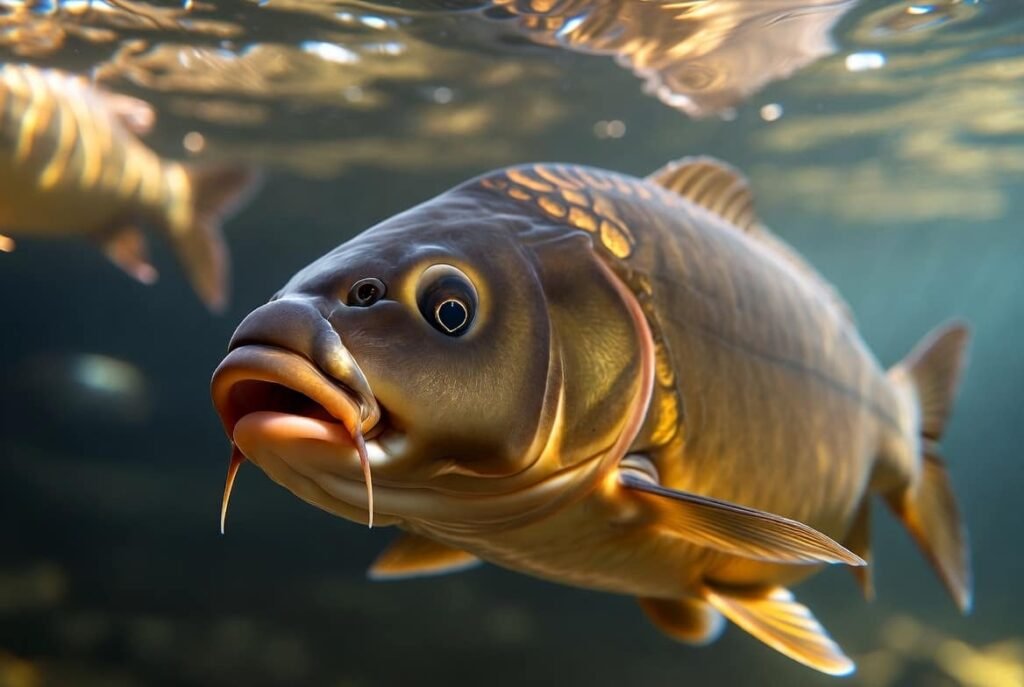
Common carp have a distinct set of physical features that make them easy to tell apart from similar looking fish once you know what to look for.
Key Identifying Features
The combination of two pairs of barbels plus serrated dorsal and anal spines is the fastest way to confirm you are looking at a common carp rather than a similar species like a buffalo fish or carpsucker, neither of which has barbels.
Image placement: insert the labeled identification photo here (barbels, serrated dorsal spine, and scale pattern callouts).
Selective breeding over centuries has produced several visually distinct varieties of common carp, all of which are still the same species, Cyprinus carpio. The differences come down almost entirely to scale pattern.
Fully Scaled Carp: This is the wild, original form of the common carp, with uniform, evenly spaced scales covering the entire body. It is the most common type found in natural rivers and lakes and is widely farmed for food across Asia and Europe.
Mirror Carp: Mirror carp have irregular, oversized, shiny scales scattered unevenly across the body, sometimes concentrated along the lateral line or back, with large patches of exposed skin elsewhere. This variety was originally bred in Europe to make cleaning and preparing the fish easier. Mirror carp are popular with anglers, particularly in European style carp fishing, because of their fast growth rate.
Leather Carp: Leather carp take the mirror carp’s reduced scale trait even further, having almost no scales at all, giving the skin a smooth, leathery appearance. They are easy to clean and are a common choice for home cooking in regions where carp is a dietary staple.
Type | Scale Pattern | Common Use |
Fully scaled | Uniform, complete coverage | Wild populations, general farming |
Mirror carp | Large, irregular, patchy scales | Sport fishing, fast growth |
Leather carp | Few or no scales | Easy cleaning, home cooking |
Koi, mentioned earlier, are a fourth variant, bred purely for color rather than scale pattern, and are typically not eaten.
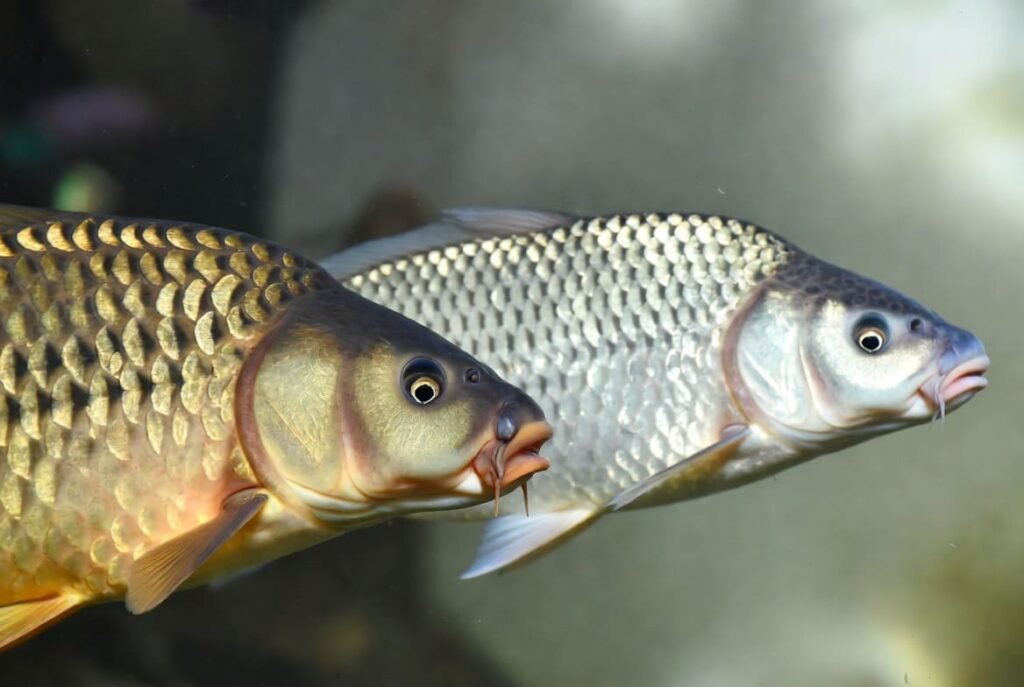
Common carp and grass carp are two of the most frequently confused freshwater fish in North America, largely because both are large, introduced species found in similar waters. Despite the shared name carp, they belong to different feeding groups and look distinctly different up close.
Feature | Common Carp | Grass Carp |
Barbels | Two pairs present | None |
Mouth | Sucker like, protruding | Terminal, no sucking adaptation |
Body color | Golden bronze to olive | Silvery white to gray |
Dorsal fin | Larger, with serrated spine | Smaller, no serrated spine |
Diet | Omnivorous: plants, insects, crustaceans | Almost entirely herbivorous |
Body shape | Deep bodied, rounded | More elongated, streamlined |
Native range | Europe and Asia | Amur River basin (China / Russia border) |
The single fastest way to tell them apart in the field is the barbels. Common carp always have two pairs near the mouth; grass carp have none at all. Body color is the second giveaway: common carp tend toward gold and bronze tones, while grass carp are noticeably more silver.
Diet also separates the two ecologically. Common carp forage by rooting through bottom sediment for insects, crustaceans, and plant matter, which stirs up mud and increases water turbidity. Grass carp, by contrast, feed almost exclusively on aquatic vegetation near the surface and mid water column, and are sometimes intentionally stocked in ponds specifically to control weed growth.
This comparison causes more confusion than any other carp topic, mainly because Asian carp is not a single species. It is an umbrella term used in North America for four fish introduced from Asia: silver carp, bighead carp, black carp, and grass carp. Common carp is a separate species entirely, introduced from Europe and Asia much earlier, in the late 1800s, and is not classified under the Asian carp group in U.S. wildlife management terminology.
Feature | Common Carp | Asian Carp (silver / bighead) |
Barbels | Two pairs present | None |
Eyes | Positioned mid body height | Positioned low on the head |
Body shape | Deep, rounded, laterally compressed | Elongated, streamlined |
Behavior | Bottom feeder, does not jump | Silver carp leap when startled by boat motors |
Diet | Omnivorous | Filter feeders, consume plankton |
U.S. introduction | Late 1800s, food and sport fish | 1970s, imported for aquaculture and water treatment |
The jumping behavior is the clearest real world giveaway. Silver carp, one of the Asian carp species, are notorious for leaping several feet out of the water when disturbed by boat engines, a behavior common carp do not exhibit. If you have seen viral videos of fish flying into boats on Midwestern rivers, that is silver carp, not common carp.
Both groups are considered invasive in parts of the United States, but they arrived at different times, spread through different mechanisms, and are managed under separate regulatory categories by state wildlife agencies.
Common carp are among the larger freshwater fish species anglers encounter in ponds, lakes, and slow rivers. Most fall well short of record breaking size, but under the right conditions, they can grow surprisingly large.
Typical Size: A mature common carp usually measures 12 to 30 inches in length and weighs between 2 and 15 pounds. In waters with abundant food and mild temperatures, adults commonly reach the 15 to 26 inch range within a few years.
Maximum Size: Under ideal conditions, ample food supply, warm water, and low predation, common carp can exceed 40 inches in length and weigh more than 35 to 40 pounds. Some wild populations in Europe and larger reservoirs in the U.S. have produced fish approaching 88 pounds.
Growth Rate
Water temperature plays the biggest role in growth rate. Common carp grow fastest in water around 18 to 20 degrees Celsius (64 to 68 degrees Fahrenheit) and become sluggish or stop feeding altogether in colder conditions, which is why carp in warmer southern climates tend to reach larger sizes faster than those in cooler northern lakes.
Carp records vary widely by region because growth potential depends on food supply, water temperature, and how long a population has been established.
United States: The Washington state record common carp weighed 49.50 lbs, caught by angler Duane Fisher at Moses Lake, Grant County, on June 17, 2006, using hook and line. Records in other states typically fall in the 30 to 45 lb range, with Connecticut’s state record standing at 39.5 lbs and 39.5 inches.
United Kingdom: The UK has a strong specimen carp fishing culture, and Homersfield Lake in Norfolk, run by the Symonds family since 1962, is one of the country’s most well known carp venues. The lake has produced multiple 50 lb plus common carp in recent years, including a 58 lb 8 oz fish caught in October 2025, and carp bred and grown on site are reportedly approaching 60 lbs. Catches at this scale sit close to the British common carp record, which itself is in the low 60 lb range.
What Drives Record Sized Carp
Record carp are almost always significantly older than average, since common carp continue growing slowly throughout their lives rather than reaching a fixed adult size.
Common carp lifespan estimates vary more than almost any other fact about the species, and that is not an error. It genuinely depends on location, predation pressure, and whether the fish is wild or captive.
Typical Wild Lifespan
In the wild, most common carp live 15 to 20 years, though this depends heavily on the ecosystem. Wildlife agencies in different regions report different ranges:
The wide gap between sources comes down to environmental pressure. In waters with heavy predation, competition, or poor water quality, few carp survive past their early teens. In stable, low predation environments, such as large reservoirs or well managed lakes, they can live several decades.
Lifespan in Captivity
Common carp live noticeably longer in captivity or controlled ponds, where they are shielded from predators and disease. Documented cases show carp living up to 47 years in captive settings, and koi, the domesticated ornamental variant of the same species, are famous for occasionally exceeding 50 years, with a few unverified claims reaching much higher.
Why the Range Is So Wide
Three factors explain most of the variation: predation levels (young carp and eggs are heavily preyed on by other fish), water quality (poor oxygen or pollution shortens lifespan considerably), and fishing pressure (catch and release fisheries, common in UK carp lakes, allow individual fish to reach old age and record sizes).
Common carp are one of the most adaptable freshwater fish species in the world, which is a major reason they have successfully spread to nearly every continent outside Antarctica.
Native Range
Common carp are native to Europe and Asia, with their original range centered around the Caspian Sea and Aral Sea basins, as well as the Danube River system in Central Europe. In their native waters, they are found in coastal brackish areas, large river estuaries, and connected freshwater systems.
Introduced Range
Common carp have since been introduced to North America, Australia, New Zealand, and parts of Africa, mostly starting in the late 1800s when they were deliberately stocked as a food fish. In the United States, they were first introduced around 1877 and are now established in 48 states.
Preferred Water Conditions
They tend to avoid clear, cold, fast flowing streams and high gradient waters, which explains why they are rare or absent in mountain streams and trout dominated rivers. Their tolerance for lower oxygen levels and moderate salinity also allows them to survive in some brackish estuaries and disturbed waterways where many native fish cannot.
Common carp are omnivorous bottom feeders, meaning they will eat almost anything they can find near the substrate, which is a major reason they thrive in so many different environments.
What Common Carp Eat
• Aquatic plants and algae, a significant part of their diet, especially in warmer months
• Insect larvae, a preferred protein source found in muddy sediment
• Crustaceans and mollusks, including small snails and freshwater mussels, which they can crush and eat shell and all
• Worms and other invertebrates living in the substrate
• Plant seeds and organic debris, including decaying vegetation
• Fish eggs, from their own species and others, when available
How They Feed
Common carp feed by sucking up mouthfuls of bottom silt and sediment, then sifting out edible particles while expelling the rest, a behavior known as benthic foraging. Their sucker like mouth and sensitive barbels are specifically adapted for locating food in low visibility, muddy conditions where sight alone would not be enough.
This feeding style has a direct ecological consequence: as carp root through the bottom in search of food, they disturb sediment, uproot vegetation, and increase water turbidity, one of the main reasons they are classified as ecologically disruptive in many non native waters.
Diet in Farmed Settings
In aquaculture, common carp are typically fed formulated pellet feed, either floating or sinking, with protein content generally lower than what is required for carnivorous fish species. Farmed carp still benefit from supplemental natural feeding when raised in ponds with existing vegetation and insect life.
Yes, common carp are considered an invasive species across large parts of North America and Australia, even though the same fish is farmed as a valuable food source in its native Europe and Asia. Its status depends entirely on region.
Why They Are Invasive Outside Their Native Range
Common carp were deliberately introduced to the United States in the late 1800s as a food fish, and to Australia in the 1960s and 70s. Without natural predators or competitors adapted to their feeding behavior, populations expanded rapidly. Today they are established in 48 U.S. states and are listed among the world’s 100 worst invasive species.
Ecological Impact
Status in Their Native Range
Ironically, in their native Europe and Asia, wild common carp populations are listed as Vulnerable on the IUCN Red List, largely due to habitat loss and hybridization with domesticated and farmed stock, which has blurred genetic lines in wild populations.
Regulation
Because of their invasive impact, most U.S. states place no bag or size limits on common carp, and some regions actively encourage removal. A few states, including Washington, still require a fishing license to target them, primarily to help enforce regulations on other protected species caught in the same waters.
Common carp have a reputation among anglers as a surprisingly powerful fighter for their size, and catching one successfully depends more on bait choice and patience than heavy tackle.
Best Baits for Common Carp
• Corn: whole kernel canned corn is considered one of the most effective and widely used carp baits
• Dough balls: a traditional bait made from bread, cornmeal, and flavoring
• Boilies: European style round baits available in a wide range of flavors, popular for targeting larger, specimen sized carp
• Worms: a reliable natural option, especially in early season
• Tiger nuts and hemp seed: popular European baits known for attracting carp over long prebaiting periods
Basic Technique Tips
Carp are notably bait shy and will often drop food the moment they feel resistance, so successful anglers use light, slack presentations:
• Use a slip or egg sinker with minimal weight, just enough to hold bottom
• Avoid bobbers, since they add resistance the fish can feel
• Cast out and allow slack line to settle rather than fishing a tight line, especially in still water
• Bait fishing on the bottom near soft, muddy areas or weed edges tends to outperform open water
Fly Fishing and Sight Fishing
Carp fly fishing has grown into a dedicated niche, particularly in clear, shallow water where anglers can sight cast to individual fish, similar to techniques used for bonefish. Spring is typically the best season, when carp move into shallow water to spawn and are more concentrated, though still easily spooked.
A Note on Catch and Cook
Because common carp carry no bag limits in most U.S. states and are considered invasive, keeping and eating your catch is both legal and, in many areas, actively encouraged as a form of population control.
Common carp is a genuinely underrated food fish nutritionally, offering a solid protein source at a lower cost than most farmed or wild caught alternatives.
Nutrition Facts (per 100g cooked serving)
Nutrient | Amount | Benefit |
Protein | 17 to 18g | Muscle growth and tissue repair |
Calories | Approximately 160 to 175 | Moderate energy density |
Total fat | 5 to 7g | Includes omega 3 fatty acids |
Vitamin B12 | Significant source | Nerve function, energy metabolism |
Vitamin D | Present | Bone health, calcium absorption |
Phosphorus | High | Bone and teeth strength |
Selenium | Present | Immune system support |
A standard 200g serving provides roughly 35g of protein, making common carp comparable to many premium fish species in protein density, at a fraction of the typical cost, since it is widely farmed and abundant.
Fats and Omega 3 Content
Common carp contains moderate levels of healthy fats, including omega 3 fatty acids, which support cardiovascular and cognitive health. It is not as fat rich as salmon or mackerel, but it offers a meaningfully better fat profile than most freshwater whitefish.
Why It Is a Practical Protein Choice
Because common carp is farmed extensively and considered invasive in many regions, it tends to be significantly more affordable and widely available than farmed salmon, trout, or tilapia, without a major nutritional trade off. This makes it a practical option for households looking for an affordable, protein dense fish.
Beyond its basic nutrition profile, common carp offers several specific health benefits that make it a worthwhile addition to a balanced diet, particularly for people looking for an affordable alternative to more expensive fish.
Supports Muscle Growth and Repair: With roughly 17 to 18g of protein per 100g serving, common carp provides a complete source of amino acids the body needs for muscle tissue repair and growth. This makes it a practical option for active individuals or anyone looking to increase protein intake without relying on red meat.
Promotes Heart and Brain Health: The moderate omega 3 fatty acid content in common carp supports cardiovascular function by helping maintain healthy cholesterol levels, and contributes to brain health and cognitive function over the long term.
Strengthens Bones and Teeth: Common carp is a solid source of both phosphorus and vitamin D, two nutrients that work together to support calcium absorption and maintain bone density, particularly important as part of a long term diet rather than a single meal.
Boosts Immune Function: The selenium content in common carp contributes to immune system support, acting as an antioxidant that helps protect cells from oxidative stress.
Supports Nerve Function and Energy: Common carp is a useful source of vitamin B12, essential for nerve function, red blood cell formation, and converting food into usable energy, a nutrient that is often lacking in plant based diets.
A Budget Friendly Nutritional Option: Because common carp is widely farmed and, in many regions, actively harvested as an invasive species, it remains one of the more affordable ways to get a nutrient dense fish onto the table regularly, without the price premium attached to salmon or tuna.
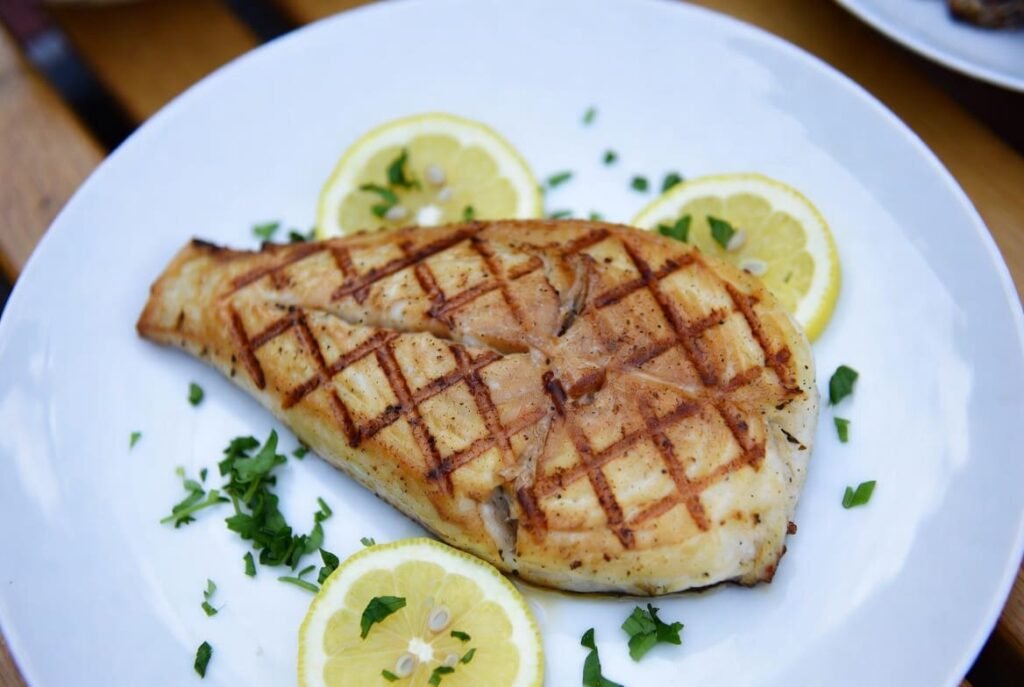
Common carp has a reputation for tasting muddy, but that is almost always a preparation issue, not a flaw with the fish itself. With the right prep, it cooks up mild, firm, and versatile enough for several different cooking methods.
Removing the Muddy Taste First
Before cooking, soak the fillets in lemon water, vinegar, or milk for 20 to 30 minutes. This step draws out compounds responsible for the earthy flavor and is considered essential by most cooks who regularly prepare carp.
Frying
Grilling
Baking
Boiling and Smoking
Two traditional preparation methods, particularly common in regions where carp has long been a dietary staple. Boiling works well for soups and stocks, while smoking is often used to offset the fish’s naturally bony structure by making the flesh easier to separate from small intramuscular bones.
A Practical Note on Bones
Common carp does contain small intramuscular bones scattered through the flesh. Proper filleting technique, combined with slow cooking methods like baking or smoking, makes them far less noticeable and easier to eat around.
Common carp availability varies significantly depending on region, since it is treated very differently depending on whether it is viewed as a food fish or an invasive species.
Live Fish Markets: In many Asian and South Asian communities, common carp is sold live at fish markets, a preferred option for buyers who want maximum freshness and are comfortable with home processing. This is the most common way to buy carp in regions where it is a dietary staple.
Farmed and Frozen Options: Common carp is farmed extensively across Asia and parts of Europe, and frozen or fresh farmed fillets are increasingly available through specialty seafood suppliers and ethnic grocery stores in the U.S., particularly in areas with larger South Asian, Eastern European, or Chinese communities.
Catch Your Own: Because most U.S. states place no bag or size limits on common carp, and many regions actively encourage harvesting them due to their invasive status, catching your own is a completely legal and often free alternative to buying. Check state specific fishing regulations and licensing requirements before keeping fish, since rules vary by state.
What to Look For When Buying
Stocking Carp for Personal Ponds
Some suppliers sell live common carp specifically for stocking private ponds, whether for personal fishing, aquaculture, or ornamental purposes, in the case of koi. Regulations around stocking non native carp vary significantly by state, so checking local wildlife agency rules first is essential.
Common carp is far more than just a pond fish people overlook. It is a remarkably adaptable species with a rich history, from its native waters in Europe and Asia to becoming one of the most widely distributed freshwater fish on the planet. Whether you are trying to identify one you have spotted, comparing it to grass carp or Asian carp, curious about its invasive status, or considering it as an affordable, protein rich food source, the common carp offers more depth than most people realize.
From its distinctive barbels and serrated fins to its impressive lifespan and record breaking size potential, common carp continues to be both a challenge for anglers and a practical choice on the dinner table. If you are planning to fish for one, catch and cook it, or simply wanted to identify a fish you spotted at your local lake, you now have a complete, science backed picture of what makes Cyprinus carpio such a resilient and fascinating species.
As search behavior increasingly shifts toward direct, answer first content and AI powered summaries, understanding a species this thoroughly, from identification to ecology to the plate, is exactly the kind of depth that continues to hold value in 2026 and beyond.
What is the scientific name of common carp?
The scientific name is Cyprinus carpio. It belongs to the family Cyprinidae, the same family as goldfish. The name itself roughly translates to carp carp, combining Greek and Latin words for carp.
How big do common carp get?
Most common carp reach 12 to 30 inches and weigh between 2 and 15 pounds. Under ideal conditions with abundant food and warm water, they can exceed 40 inches and 35 to 40 pounds, with some individuals approaching 88 pounds.
What is the world record for common carp?
Records vary by region. The Washington state record is 49.50 lbs, caught in 2006. In the UK, Homersfield Lake has produced multiple carp over 50 lbs, with the British common carp record sitting in the low 60 lb range.
How long do common carp live?
Wild common carp typically live 15 to 20 years, though estimates range from 13 to 50 years depending on the source and location. In captivity, sheltered from predators, they can live up to 47 years or longer.
What do common carp eat?
Common carp are omnivorous bottom feeders, eating aquatic plants, insect larvae, crustaceans, mollusks, worms, seeds, and organic debris. They forage by sucking up sediment and filtering out edible particles.
Are common carp invasive?
Yes, in most of North America and Australia. They are established in 48 U.S. states and listed among the world’s 100 worst invasive species, due to their impact on water clarity and native vegetation. In their native Europe and Asia, wild populations are actually listed as Vulnerable.
What is the difference between common carp and grass carp?
Common carp have two pairs of barbels and a golden bronze color; grass carp have no barbels and are silvery white. Common carp are omnivorous bottom feeders, while grass carp feed almost exclusively on aquatic vegetation.
What is the difference between mirror carp and common carp?
Mirror carp is a scale variant of the same species, Cyprinus carpio, not a separate species. It has large, irregular, patchy scales instead of the uniform scale coverage found on a standard fully scaled common carp.
What is the best bait for common carp?
Whole kernel corn is considered the most effective and widely used bait, followed by dough balls, boilies, and worms. Carp are bait shy, so light, low resistance presentations generally outperform heavier rigs.
Can you eat common carp, and is it safe?
Yes, common carp is safe and nutritious to eat, offering about 35g of protein per 200g serving. Soaking the fillets in lemon water, vinegar, or milk before cooking removes the earthy muddy flavor some people associate with the fish.

Fish Info Guide helps you explore edible, freshwater, saltwater, and aquarium fish – with simple guides on nutrition, care, and species identification for beginners and enthusiasts alike.
Imortant Links
Quick Links
Subscribe Our Newsletter
Get the latest fish care tips, species guides, and nutrition insights delivered straight to your inbox.