

Bringing home a few mollies fish is easy. Keeping them healthy for years is where most beginners struggle. Mollies fish are among the most popular freshwater aquarium fish in the world, known for their bold colors, peaceful nature, and easy livebearing reproduction. They belong to the Poecilia genus and originate from the freshwater and brackish habitats of Central America and the southern United States.
This guide covers everything you need to know: the different types of mollies fish, correct tank setup and water temperature, what to feed them, whether they actually need salt in their water, how to tell males from females, and what to expect when they breed. Whether you are picking your first molly or troubleshooting a health issue, this article gives you the complete, practical answer.
In short: mollies fish are hardy, adaptable, social fish that thrive in a properly cycled 20 gallon or larger tank with stable water parameters, a balanced omnivorous diet, and compatible tank mates.
Mollies fish are small to medium sized freshwater livebearers belonging to the genus Poecilia, part of the larger Poeciliidae family that also includes guppies. The name “molly” covers several closely related species, most notably Poecilia sphenops (short fin molly), Poecilia latipinna (sailfin molly), and Poecilia velifera (Yucatan molly). Decades of selective breeding have produced the colorful hybrid varieties sold in pet stores today.
In the wild, mollies are native to freshwater rivers, streams, and coastal brackish lagoons stretching from the southern United States through Mexico and into Central America. This natural flexibility explains why mollies fish tolerate a wide range of water conditions better than most tropical fish.
Quick facts about mollies fish:
What sets mollies fish apart from many other aquarium species is their combination of hardiness and visual variety. A single tank of mollies can display a dozen different color patterns while all sharing the same basic care needs, which is a big part of why they remain a staple in the aquarium hobby.
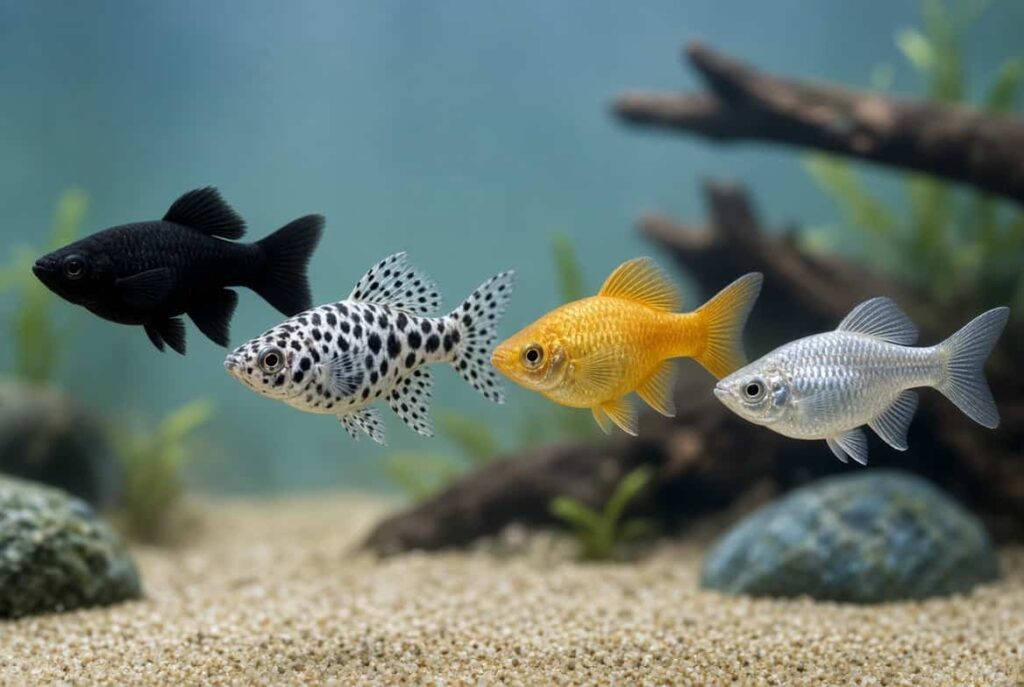
There are over 20 recognized molly species in the wild, but selective breeding has produced far more color and fin variations for the aquarium trade. Below are the most common types of mollies fish you will find at local fish stores and online retailers.
Black Mollies
Black mollies are the most recognizable type, prized for their solid, sleek black coloration from head to tail. They are hardy, peaceful, and one of the easiest mollies for beginners to keep successfully in a community tank.
Dalmatian Mollies
Dalmatian mollies have a white or silvery base covered in irregular black spots, resembling the dog breed they are named after. Their playful pattern makes them a popular centerpiece fish in mixed species aquariums.
Sailfin Mollies
Sailfin mollies, or Poecilia latipinna, are known for their large, fan like dorsal fin. Males display this fin during courtship, and the species grows larger than most other mollies, often reaching 4 to 5 inches.
Lyretail Mollies
Lyretail mollies have an extended, lyre shaped caudal fin that flows elegantly as they swim. They come in gold, black, silver, and dalmatian color combinations and need stable water to keep their long fins healthy.
Balloon Mollies
Balloon mollies have a rounded, compact belly caused by selective breeding for a shortened spine. While charming, this trait can shorten their lifespan and cause swimming or buoyancy difficulties.
Gold Dust Mollies
Gold dust mollies feature a golden yellow body speckled with fine black flecks. They are active swimmers that add a warm splash of color to planted tanks.
Marble Mollies
Marble mollies display a mottled mix of black, white, and gray patches, giving each fish a unique pattern. No two marble mollies look exactly alike.
Panda and Golden Panda Mollies
Panda mollies combine black and white or black and gold patches concentrated around the head and fins, resembling their namesake animal. They are a favorite among collectors seeking distinctive patterns.
Silver Mollies
Silver mollies have a shimmering, metallic silver body that reflects light beautifully under aquarium lighting. They are social and do best in small groups.
Yucatan Mollies
Yucatan mollies, or Poecilia velifera, are a large sailfin type native to Mexico’s Yucatan Peninsula. They need more swimming space and slightly harder water than smaller molly types.
Swordtail Mollies
Sometimes confused with true swordtails, swordtail mollies simply refer to molly hybrids with an elongated lower caudal fin extension, giving a similar sword like appearance without being a separate species.
How big do mollies get? Most mollies fish reach an adult size of 3 to 5 inches (7.5 to 12.5 cm), depending on the species and gender. Sailfin and Yucatan mollies grow largest, sometimes reaching 5 inches, while short fin varieties like black mollies typically stay closer to 3 to 4 inches.
Females are almost always larger and rounder bodied than males, especially once they reach breeding age. Males stay slimmer and are easy to identify by their modified anal fin, which is covered in more detail later in this guide.
Mollies fish lifespan: With proper care, mollies typically live 3 to 5 years in a home aquarium. Several factors directly affect how long a molly lives:
In terms of appearance, mollies fish grow gradually over their first 4 to 6 months, reaching full size and mature coloration by around 8 months to a year. Juvenile mollies often start out with duller, washed out colors that intensify as the fish matures, so a young molly rarely reflects its true adult coloration right away.
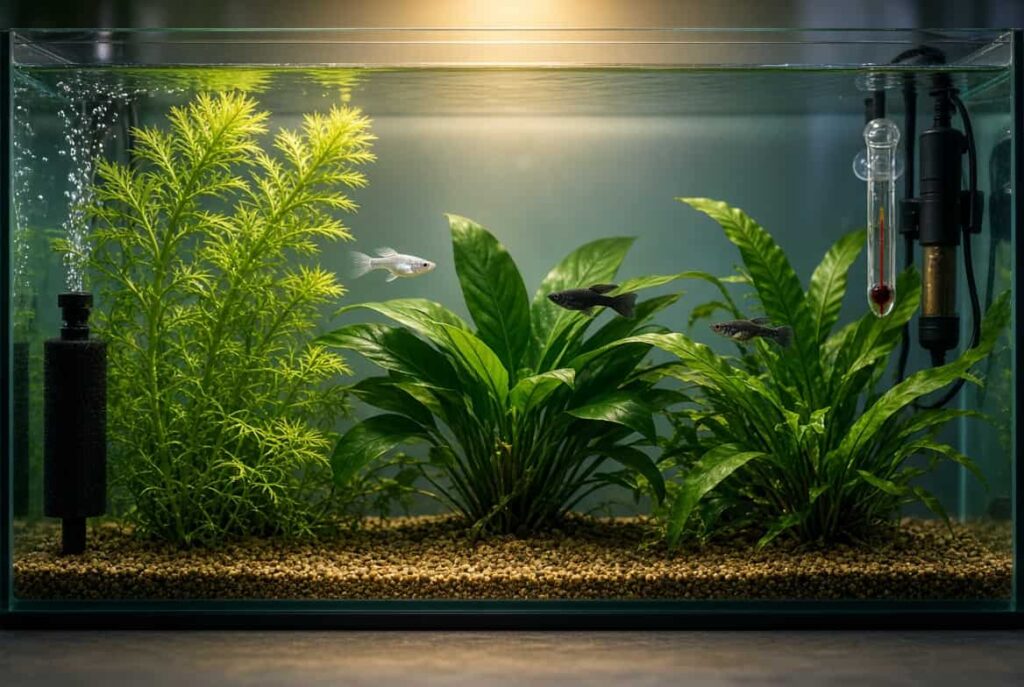
A stable, well planned tank is the single biggest factor in keeping mollies fish healthy long term. Getting the setup right from day one prevents most of the stress related illnesses mollies are known for.
Tank Size
A 20 gallon tank is the minimum recommended size for a small group of mollies fish. Since mollies are active swimmers and prolific breeders, a 29 to 40 gallon tank is a better long term choice, especially for larger sailfin or Yucatan varieties. As a general rule, plan for at least 3 gallons of water per adult molly to avoid overcrowding and aggression.
Water Temperature
Mollies fish need a water temperature between 75°F and 82°F (24°C to 28°C). A reliable aquarium heater and thermometer are essential, since sudden temperature swings weaken their immune system and trigger disease outbreaks like ich or fin rot.
pH, GH, and KH
Mollies prefer slightly alkaline, moderately hard water:
Soft, acidic water stresses mollies over time, so testing your tap water before stocking is a smart first step.
Filtration and Substrate
A sponge filter or hang on back filter provides the biological and mechanical filtration mollies need to stay ammonia free. Fine gravel or sand substrate works well, gives a natural look, and makes routine cleaning easier.
No, mollies fish do not require salt in their water to survive. This is one of the most persistent myths in the aquarium hobby, and clearing it up can save you from unnecessary stress and expense.
The confusion exists because many mollies sold in pet stores are raised on fish farms that use brackish water, since it happens to be cheaper than treated fresh water in some regions. When these fish are transported to freshwater tanks, the sudden change in water chemistry can shock their system, leading hobbyists to assume mollies “need” salt when really they were simply adjusting to a new environment.
In truth, wild mollies are euryhaline, meaning they can tolerate a wide range of salinities from fully fresh to fully brackish, but they do not depend on salt to thrive. Mollies kept in stable, well filtered freshwater with consistent water changes do just as well as those kept with added salt.
That said, aquarium salt still has legitimate uses for mollies:
If you do use salt, stick to actual aquarium salt, not table salt or marine salt, and use it as a short term remedy rather than a permanent additive, since consistent salt levels can harm live plants in a mixed tank.
Mollies fish are omnivores, meaning a healthy diet needs a mix of protein and plant matter. In the wild, they graze constantly on algae, small invertebrates, and plant debris, and replicating that variety in captivity keeps them healthiest.
A balanced diet for mollies fish should include:
Best fish food for mollies is one that lists real protein sources first and includes spirulina or other plant based ingredients, since mollies need more vegetable matter than strictly carnivorous fish like bettas.
Feed mollies fish two to three small meals per day rather than one large feeding, giving them only what they can finish within two to three minutes. A helpful rule of thumb is that a fish’s stomach is roughly the size of its eye, so overfeeding is more common than underfeeding.
Watch for warning signs of poor diet or overfeeding, such as long stringy waste trailing from the fish or excess uneaten food fouling the water. Skipping food one day a week also supports healthy digestion and helps prevent constipation, a common issue in overfed mollies.
Mollies fish are peaceful and social, which makes them easy to pair with a wide range of community fish. The key is choosing species with similar water parameter needs and a similar activity level, since slow moving or long finned fish can become targets for occasional nipping.
Good tank mates for mollies fish include:
Tank Mate | Why It Works |
Platies and swordtails | Same family, similar temperament and water needs |
Corydoras catfish | Peaceful bottom dwellers, rarely interact with mollies |
Guppies | Similar size, activity level, and care requirements |
Tetras (neon, black neon, glowlight) | Fast swimmers, peaceful, fill the mid water column |
Danios and barbs | Active and hardy, match molly energy levels |
Freshwater snails and shrimp | Help with tank cleanup, low conflict risk |
Can mollies live with guppies? Yes, mollies and guppies are one of the most common and successful community pairings, since both are livebearers with nearly identical water and diet requirements.
Can mollies live with goldfish? This is not recommended. Goldfish need cooler water than mollies and produce far more waste, creating conflicting tank conditions.
Can mollies live with bettas? It depends. A calm betta can sometimes coexist with mollies, but bettas may nip at long finned varieties like sailfin or lyretail mollies, so caution and close observation are needed.
Avoid pairing mollies with aggressive fin nippers like tiger barbs or larger cichlids, which can stress or injure them.
Sexing mollies fish is straightforward once you know what to look for, and getting it right matters if you want to control breeding in your tank.
The clearest difference is the anal fin:
Other visible differences between male and female mollies:
Sexing becomes reliable once mollies reach about 3 months of age. Before that, juveniles of both sexes look almost identical and are usually mistaken for females.
If you want to prevent constant breeding, keeping only one sex in a tank is the simplest solution, since even a single male and female pair will reproduce quickly under normal conditions.
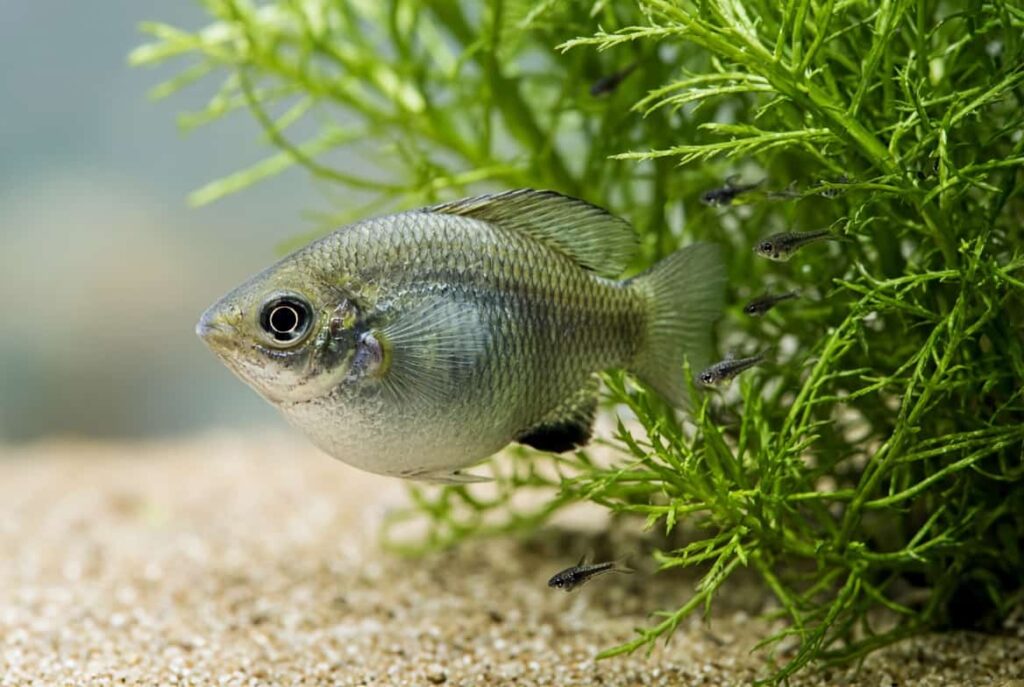
Mollies fish are prolific breeders, and understanding their reproduction cycle helps you manage population growth or intentionally raise healthy fry.
Are Mollies Livebearers?
Yes, mollies are livebearers. Unlike egg laying fish, female mollies retain fertilized eggs internally and give birth to fully formed, free swimming fry. This process is called ovoviviparity, meaning the young develop inside an egg within the mother rather than growing directly through a placental connection like mammals.
Mollies fish have a gestation period of about 4 weeks, though this can extend to 6 weeks depending on water temperature and conditions. Warmer water tends to shorten gestation slightly. A pregnant molly develops a boxy, distended shape near the end of her term, and many females also show a dark gravid spot near the tail that indicates how close they are to giving birth.
A first time mother typically releases 10 to 20 fry, while experienced, mature females can produce 40 to 100 fry in a single batch. Births sometimes happen in two waves spaced several hours apart. Females can also store sperm and become pregnant again almost immediately after giving birth, so a molly tank without separated sexes will breed continuously.
Newborn mollies are fully capable of swimming and eating immediately, but adult fish, including their own parents, will eat them if given the chance. To improve fry survival:
Fry typically reach juvenile size within 4 to 6 months, at which point their sex becomes distinguishable and their adult coloration starts to develop.
Mollies, platies, and guppies are often confused since all three are peaceful, colorful livebearers commonly sold together at pet stores. Here is how they actually compare.
Feature | Mollies | Platies | Guppies |
Adult size | 3 to 5 inches | 2 to 3 inches | 1.5 to 2.4 inches |
Lifespan | 3 to 5 years | 3 to 5 years | 2 to 3 years |
Water preference | Alkaline, tolerates brackish | Slightly alkaline, freshwater | Neutral to slightly alkaline |
Temperament | Peaceful, active | Very peaceful, calm | Peaceful, very active |
Breeding rate | High | High | Very high |
Fin variety | Sailfin, lyretail, balloon | Rounded, simple fins | Elaborate tails, most varieties |
Best for | Intermediate beginners | True beginners | Colorful community tanks |
Mollies vs platies: Mollies grow larger, tolerate a wider salinity range, and generally need slightly more stable, harder water than platies. Platies are considered the easier and more forgiving choice for absolute beginners, while mollies reward slightly more attentive care with more color and fin variety.
Mollies and guppies: These two pair extremely well in the same tank, since both share nearly identical water and dietary needs. The main difference is size and fin flamboyance, guppies are smaller with more elaborate tails, while mollies are larger and hardier overall.
All three species can technically interbreed with closely related species in rare cases, but the resulting offspring are usually sterile and not recommended for intentional breeding.
Even hardy mollies fish can develop health problems when water quality slips or stress builds up. Recognizing symptoms early makes treatment far more effective.
Common molly fish health issues:
Prevention matters more than treatment for mollies fish. Most health problems trace back to three root causes:
Weekly water testing, gradual acclimation when introducing new fish, and consistent water changes of 20 to 25 percent solve the majority of molly health issues before they start.
Mollies fish are widely available, but where you buy them affects both price and the long term health of your fish.
Where to buy mollies fish:
Mollies fish price generally falls into these ranges:
Type | Typical Price Range |
Common black or silver mollies | $3 to $6 each |
Dalmatian or gold dust mollies | $5 to $8 each |
Sailfin or Yucatan mollies | $7 to $12 each |
Lyretail or balloon mollies | $6 to $10 each |
Rare panda or marble mollies | $10 to $15 each |
When buying mollies fish for sale, avoid tanks that show any dead or visibly sick fish, since diseases like ich spread quickly among tank mates before symptoms become obvious. Buying two to three females per male from the start also helps establish a balanced, less stressful group dynamic right away.
Mollies fish remain one of the best choices for anyone building a peaceful, colorful freshwater community tank. As this guide has shown, success comes down to a few fundamentals: a stable 20 gallon or larger tank, consistent water temperature between 75°F and 82°F, a varied omnivorous diet, and compatible tank mates. Understanding their breeding cycle and knowing how to spot early health issues will save you time and prevent common beginner mistakes.
Whether you are drawn to the sleek look of black mollies or the dramatic fins of a sailfin variety, mollies fish reward attentive, informed care with years of activity and color in your aquarium. As more hobbyists turn to research before buying, having accurate, up to date information like this will only become more valuable for building a thriving, long term tank.
What are mollies fish?
Mollies fish are freshwater livebearing fish from the genus Poecilia, native to Central America and the southern United States. Known for their peaceful temperament and wide color variety, they are popular beginner to intermediate aquarium fish that give birth to live, free swimming fry rather than laying eggs.
Do mollies fish need salt in their water?
No, mollies do not require salt to survive. While they can tolerate brackish conditions since they are euryhaline, stable freshwater with consistent water changes keeps them just as healthy. Aquarium salt is only useful short term for treating illness or easing acclimation stress.
How big do mollies fish get?
Most mollies fish reach 3 to 5 inches as adults, depending on the species. Sailfin and Yucatan mollies grow largest, sometimes reaching 5 inches, while short fin types like black mollies typically stay closer to 3 to 4 inches at full maturity.
How long are mollies pregnant?
Mollies fish have a gestation period of roughly 4 weeks, occasionally extending to 6 weeks depending on water temperature. Warmer water tends to shorten the pregnancy slightly, and females often develop a boxy shape and a visible gravid spot near the end of term.
How many fry do mollies have at once?
A first time mother usually has 10 to 20 fry, while mature, experienced females can produce 40 to 100 fry per batch. Mollies can also become pregnant again immediately after giving birth, so populations grow quickly without separating the sexes.
Can mollies live with guppies?
Yes, mollies and guppies are a highly compatible pairing since both are livebearers with nearly identical water parameter and dietary needs. They differ mainly in size and fin style, making them a common and successful community tank combination.
What is the difference between mollies and platies?
Mollies grow larger, tolerate a wider salinity range, and need slightly harder, more alkaline water than platies. Platies are generally considered more forgiving for absolute beginners, while mollies offer greater color and fin variety for slightly more experienced keepers.
What do mollies fish eat?
Mollies are omnivores that need both protein and plant matter. A balanced diet includes high quality flakes or pellets, frozen or live brine shrimp and bloodworms, blanched vegetables, and occasional algae wafers, fed two to three times daily in small portions.
How many mollies can I keep in a 20 gallon tank?
A 20 gallon tank comfortably holds 4 to 6 mollies, following the guideline of roughly 3 gallons per adult fish. Larger sailfin or Yucatan varieties need more space, so a 29 to 40 gallon tank is better for those types long term.
Are mollies fish easy to care for?
Yes, mollies fish are considered easy to moderate in care level, making them suitable for beginners willing to maintain stable water temperature and quality. Their main challenges are rapid breeding and sensitivity to sudden changes in water parameters rather than complex daily care.

Fish Info Guide helps you explore edible, freshwater, saltwater, and aquarium fish – with simple guides on nutrition, care, and species identification for beginners and enthusiasts alike.
Imortant Links
Quick Links
Subscribe Our Newsletter
Get the latest fish care tips, species guides, and nutrition insights delivered straight to your inbox.