

Your betta flares at every fish you add, and now you’re wondering if this species is simply meant to live alone forever. The good news is that many betta owners build calm, thriving community tanks once they understand what actually works. Choosing the right betta splendens tank mates comes down to three things: temperament, tank size, and fin shape, not luck. In short, bettas can live with peaceful, fast, short finned species in a tank of 10 gallons or more, though every individual betta reacts differently. This guide walks through which fish, snails, and shrimp make safe companions, which ones to avoid, and how to introduce new tank mates without triggering a territorial attack. You’ll also find quick answers on heaters, feeding schedules, and adult size so your whole setup supports a peaceful, healthy tank.
Yes, betta fish can live with other fish, but success depends on the individual betta’s temperament, not just the species you choose. Betta splendens were selectively bred for centuries as fighting fish, so a strong territorial instinct is baked into the breed. Some bettas stay calm around tank mates for years. Others treat every new arrival as a rival worth attacking.
Three factors decide whether a tank mate will actually work:
Water conditions matter too. Betta fish thrive in soft, slightly acidic water, so tank mates that need harder, more alkaline water (like many platies) are a poor match even if their temperament is fine.
If you’re building a community tank, always have a backup tank ready. Even a betta with a peaceful track record can turn on a companion without warning, and you’ll want somewhere safe to separate them quickly.
Two male bettas should never share a tank. Males are so territorial that they will fight, often to the death, if housed together regardless of tank size. This instinct is exactly why the species earned the nickname Siamese fighting fish.
A male and female betta can coexist only under very specific, supervised conditions, typically for breeding, and even then only for short, monitored periods. Outside of breeding, pairing a male and female long term usually ends in injury to one or both fish.
Female bettas are a different story. While still capable of aggression, females tend to be more tolerant of their own kind than males are. This opens the door to a setup called a sorority, where multiple females share a larger tank. It’s not automatic peace, though. A poorly planned sorority can be just as dangerous as putting two males together.
Quick rule of thumb:
If you want more than one betta in your aquarium, a sorority is the realistic path, and it comes with its own set of rules.
A betta sorority is a group of female betta splendens kept together in one aquarium. It works because females establish a pecking order rather than fighting to the death like males do, but it only succeeds with the right numbers and setup.
Key requirements for a stable sorority:
Even with a well planned sorority, some hierarchy squabbling is normal in the first few weeks. What you’re watching for is prolonged, one sided aggression, like a single female with torn fins who is constantly hiding or refusing food. That fish may need to be removed for her own safety.
Sororities are rewarding but not beginner proof. If you’re newer to betta care, start with a single female and simple tank mates before attempting a group.
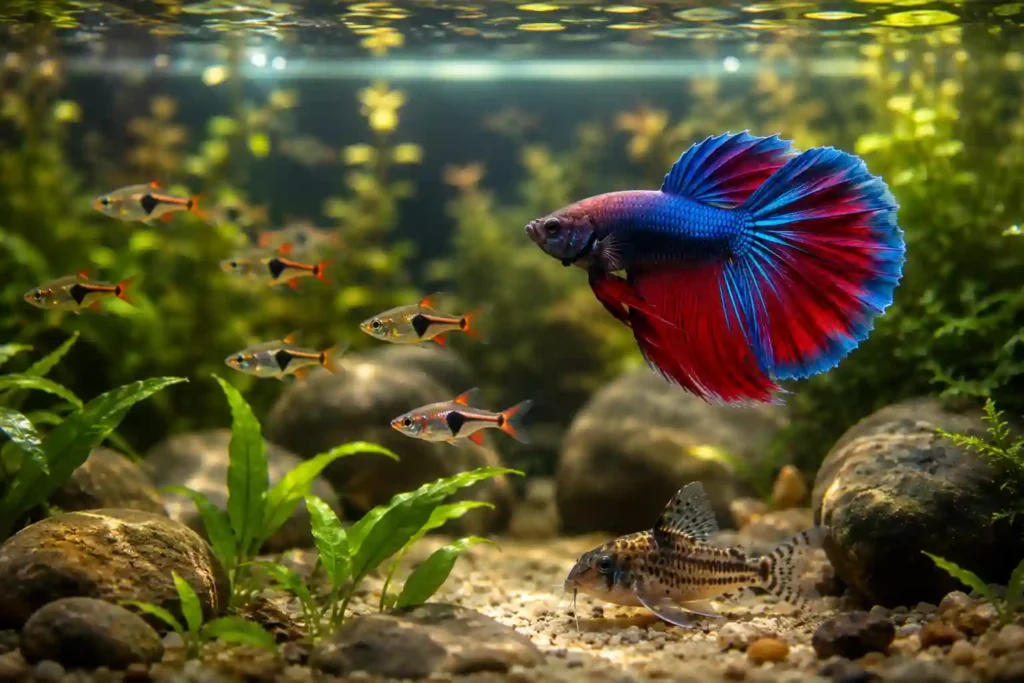
The safest tank mates share three traits: they’re fast enough to avoid a betta’s attention, they have short fins that don’t get mistaken for a rival, and they stay out of the betta’s territory for most of the day. A handful of species consistently fit that profile.
Corydoras catfish are bottom dwellers that rarely interact with a betta at all, making them one of the most reliable choices for a community tank. They’re peaceful, easy to care for, and help clean up leftover food.
Harlequin rasboras are considered by many experienced keepers to be among the best betta tank mates. They naturally share habitat with bettas in the wild, grow to about 2 inches, and move in tight schools that discourage one on one confrontation.
Ember tetras and neon tetras work well too. Their small size and calm schooling behavior keep them low on a betta’s radar, though a school of 6 or more is ideal so no single fish gets isolated. See our full neon tetra fish guide for tank setup and care details.
Kuhli loaches are another bottom dwelling option. They’re nocturnal, slender, and spend most of their time tucked into substrate or hiding spots, so they rarely cross paths with a betta.
Celestial pearl danios round out the list. They stay under an inch, move quickly, and lack the bright, flashy coloring that tends to provoke bettas.
Species to lean toward in general: short finned, fast moving, dull or muted colored, and either schooling or bottom dwelling. Avoid anything that lingers near the surface or middle of the tank where a betta patrols.
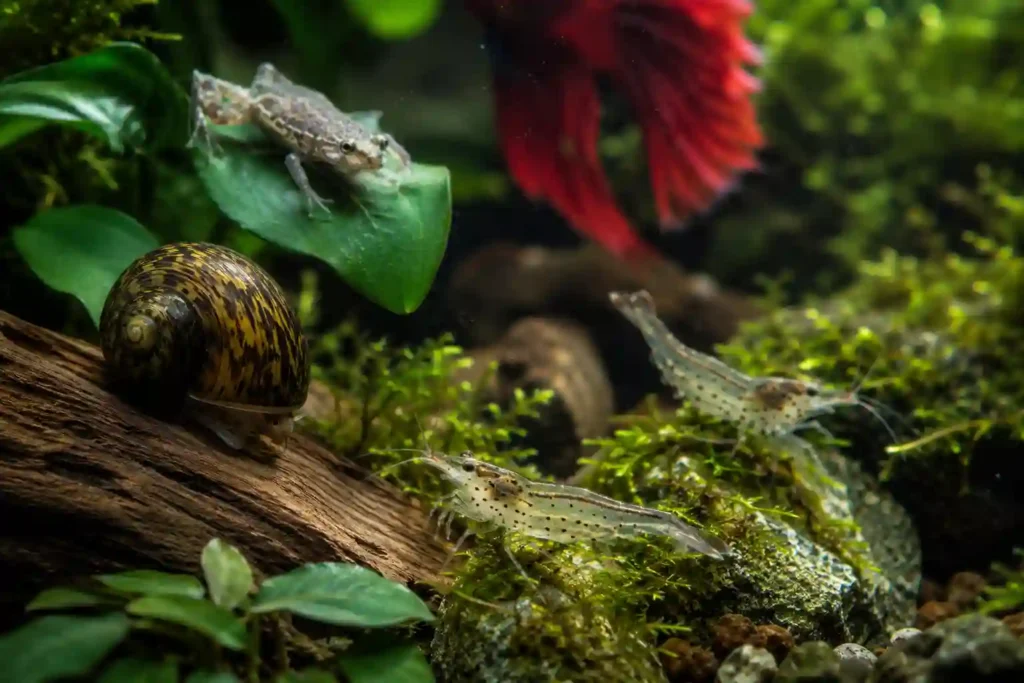
Invertebrates are often the easiest starting point for a betta community tank because most don’t compete for the same space or resemble a rival fish.
Snails are a popular first tank mate. Nerite snails and mystery snails both work well since their hard shells protect them from curious nibbling, and they help keep the tank clean by grazing on algae and leftover food. Bettas generally ignore snails entirely once they realize they’re not a threat or a meal.
Shrimp can also make good companions, though the outcome depends heavily on species and size. Ghost shrimp and amano shrimp are large and fast enough to usually avoid becoming a snack, and they spend most of their time along the substrate, away from a betta’s usual territory. Smaller or brightly colored shrimp, like cherry shrimp, are riskier since some bettas will eat them given the chance.
African dwarf frogs are another peaceful option. They’re calm, easy to care for, grow to around 2.5 inches, and typically coexist well with bettas. Keep in mind they need a way to reach the water’s surface to breathe, so tank design matters here.
A few practical notes for invertebrate tank mates:
Some species are consistently poor matches for betta splendens, regardless of tank size or individual temperament. Knowing what to avoid saves you from a stressful, and often fatal, introduction.
Other bettas of any species top this list. Two males will fight without exception, and even male female pairings outside of controlled breeding tend to end badly.
Bright, long finned fish like fancy guppies are a common mistake. Their flowing tails and vivid colors closely resemble another betta, which frequently triggers territorial attacks rather than curiosity.
Fin nippers such as tiger barbs and some tetra species are a double risk. They can nip at a betta’s delicate fins, and a betta that fights back can just as easily injure them in return.
Species needing different water chemistry are an overlooked problem. Platies, for example, need harder, more alkaline water than bettas naturally thrive in. Even a perfectly calm platy becomes a poor tank mate if the water parameters can’t support both fish long term. Livebearers like mollies fall into this same category and need careful water testing before being considered.
Very small or slow moving fish without armor or speed, like small brightly colored shrimp, are at risk of simply being eaten.A simple filter to apply before adding any tank mate: if the species is bright, long finned, aggressive, a fin nipper, or requires different water chemistry, it’s not a safe match. When in doubt, choose a species known to thrive in the same soft, warm water bettas need
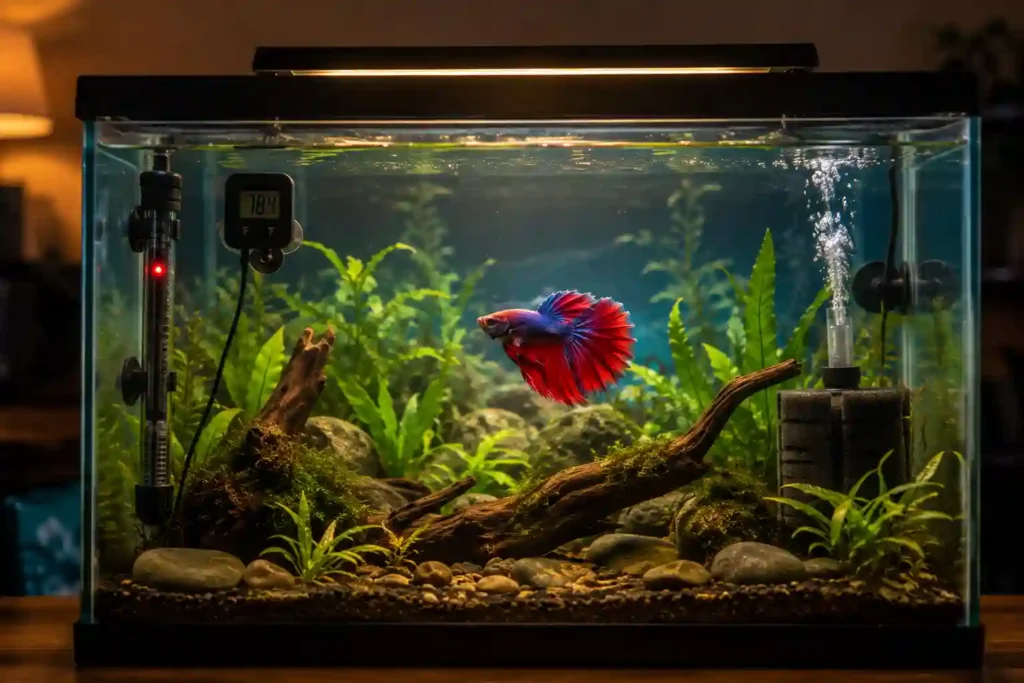
Tank size is one of the biggest factors in whether a community setup succeeds. A single betta can technically survive in a tank as small as 3 to 5 gallons, but that’s not enough room once you add tank mates. For any community setup, aim for 10 gallons minimum, and go larger if you’re keeping a school of fish or a sorority.
A well designed betta community tank needs a few key elements:
One setup trick many experienced keepers use: add the other tank mates first and let them settle in for a few weeks before introducing the betta. This lets the betta arrive into an already established environment rather than feeling like its territory is being invaded, which can reduce aggression from day one.
Stable water quality also matters as much as layout. Weekly partial water changes of 20 to 30 percent help keep parameters consistent, and consistency reduces stress for every fish in the tank, not just the betta.
Yes, betta fish need a heater in almost every home setup. Bettas are tropical fish native to the warm waters of Southeast Asia, and they need a stable water temperature between 76 and 81°F to stay healthy and active. Unless your room stays consistently in that range year round, which is rare, a heater is essential equipment rather than an optional extra.
A common mistake is assuming a warm house means no heater is needed. Even if daytime temperatures sit in a comfortable range, most homes cool down at night, and that fluctuation is more stressful to a betta than a consistently cooler tank would be. Temperature swings can weaken a betta’s immune system and make it more prone to illness.
When choosing a heater, a simple rule of thumb is 3 to 5 watts per gallon of water. So a 5 gallon tank generally needs a small heater in the 15 to 25 watt range, while larger community tanks need proportionally more power. Pair the heater with a reliable thermometer, since heaters can fail or drift out of calibration without any obvious sign.
A few signs your betta’s tank is running too cold:
If you notice these signs, check your heater and thermometer before assuming illness. Temperature is one of the first things to rule out.
A typical betta splendens grows to about 2.5 to 3 inches in body length, not counting the flowing fins that can add another inch or more to their overall appearance. Most bettas reach their full adult size within 6 to 8 months, though growth can continue more slowly for several months after that.
There are a few exceptions worth knowing:
Adult size matters for tank planning in two ways. First, it confirms that even a solo betta needs more room than a small bowl, since a mature betta with full fins needs space to swim and turn comfortably. Second, it affects tank mate selection. A grown betta with long, dramatic fins is more likely to be perceived as a rival by other bettas and may also draw more attention from fin nipping species, so fin type is worth factoring in alongside body size when planning a community tank.
Feed an adult betta fish once or twice a day, offering only what it can finish in about two minutes per feeding. Bettas are carnivores, so a high protein pelleted food formulated specifically for the species should make up the bulk of their diet.
A helpful portion guideline: feed roughly the amount of food that would fit inside your betta’s eyeball per meal. Depending on the brand, that usually works out to about 2 to 4 pellets per feeding. If you’re feeding twice a day, split that portion across both meals rather than doubling it.
A few practical feeding tips:
If your betta refuses food for more than a day or two outside of an intentional fast, it’s worth checking water temperature and quality before assuming illness, since both commonly affect appetite first.
Even the best species match can fail if tank mates are introduced carelessly. A slow, deliberate process gives every fish the best chance at settling in peacefully.
Add other fish before the betta when possible. Letting tank mates establish territory for a few weeks before the betta arrives reduces the chance that the betta sees the whole tank as something it needs to defend from scratch.
Quarantine new arrivals first. A 2 to 4 week quarantine in a separate tank helps catch illness or parasites before they reach your main aquarium, protecting both the betta and its new companions.
Introduce fish gradually, not all at once. Adding one species at a time, spaced a week or two apart, makes it easier to track how the betta reacts to each new addition and to intervene quickly if something goes wrong.
Rearrange decor before adding new fish. Shifting plants, driftwood, or ornaments slightly disrupts the betta’s existing territory markers, which can reduce possessive aggression toward newcomers.
Watch closely for the first week. Signs of stress to monitor in both the betta and its tank mates include:
Always keep a backup tank ready. If aggression doesn’t settle within a week or two, or if injuries appear, separate the aggressor immediately. Some bettas simply won’t tolerate company no matter how carefully you introduce it, and that’s a normal outcome, not a failure on your part.
Building a peaceful home for betta splendens tank mates comes down to matching the right species, giving them enough room, and introducing everyone carefully. Corydoras catfish, harlequin rasboras, and peaceful invertebrates like nerite snails and amano shrimp tend to work best, while bright, long finned, or aggressive species are worth avoiding entirely. A tank of at least 10 gallons, stable heated water between 76 and 81°F, and a slow, monitored introduction process give any community tank the best chance of success.
Every betta is still an individual, so even a well planned setup deserves patience and close observation in the first few weeks. If aggression shows up despite doing everything right, that’s not a failure, it’s simply part of keeping this species. As more aquarists share real world results and AI powered search tools surface community proven advice, betta care in 2026 continues to shift toward individualized, welfare focused setups rather than one size fits all rules. Start with a solid foundation, watch your betta’s behavior closely, and adjust as needed. For a broader look at day to day care, see our full betta fish care guide, and browse more species profiles on our Aquarium Fish category page
Can betta fish live with other fish?
Yes, many bettas can live with peaceful, fast, short finned tank mates in a tank of 10 gallons or more. Success depends on the individual betta’s temperament as much as the species chosen, so always monitor closely after introducing new fish.
Can two male bettas live in the same tank?
No. Male bettas are extremely territorial and will fight, often fatally, if housed together regardless of tank size. Each male betta needs its own separate tank.
What is the best tank size for a betta with tank mates?
A minimum of 10 gallons is recommended for a betta community tank. Sororities of female bettas need at least 20 gallons to give each fish enough space to establish territory.
Do betta fish need a heater?
Yes. Bettas are tropical fish that need stable water between 76 and 81°F. A heater is essential in almost every home, since natural room temperature swings are stressful even if daytime temps seem warm enough.
How often should you feed a betta fish?
Feed adult bettas once or twice daily, offering only what they can eat in about two minutes. Roughly 2 to 4 pellets per feeding is typical, split across meals if feeding twice a day.
How big do betta fish get?
Most betta splendens reach 2.5 to 3 inches in body length, reaching full size within 6 to 8 months. Giant betta varieties can grow closer to 5 inches.
Can betta fish live with shrimp?
Yes, larger shrimp like ghost or amano shrimp often coexist well with bettas. Smaller or brightly colored shrimp, like cherry shrimp, carry more risk of being eaten.
Why is my betta attacking its tank mates?
This usually comes down to territorial instinct, bright colors, or long fins that resemble another betta. Some individual bettas simply won’t tolerate any tank mates, regardless of species chosen.
Can female betta fish live together?
Yes, in a properly set up sorority of 4 to 6 or more females in a 20 gallon or larger tank. Smaller groups often lead to one female being singled out and bullied.
What fish should never be kept with a betta?
Avoid other bettas, bright or long finned fish like fancy guppies, known fin nippers like tiger barbs, and species that need very different water chemistry, such as platies.

Fish Info Guide helps you explore edible, freshwater, saltwater, and aquarium fish – with simple guides on nutrition, care, and species identification for beginners and enthusiasts alike.
Imortant Links
Quick Links
Subscribe Our Newsletter
Get the latest fish care tips, species guides, and nutrition insights delivered straight to your inbox.