

Edible fish are rich in high-quality protein, omega-3 fatty acids, and essential vitamins.
Freshwater fish also provide excellent nutritional value, including lean protein and minerals.
Saltwater fish are highly beneficial for health due to their high omega-3 content.
aquarium fish are mainly kept for decoration, some offer nutritional benefits.
Fish can be grouped in different ways, depending on where they live, how they are used, and how scientists classify them. In everyday terms, people commonly search for edible fish, freshwater fish, saltwater fish, and aquarium fish. These categories can overlap because one species may belong to more than one group.
For example, tilapia is a freshwater fish that is also widely farmed for food, while goldfish are freshwater fish commonly kept in aquariums. Salmon can spend different parts of its life in both freshwater and saltwater.
In this guide, you’ll learn how these groups differ, see common examples, and understand the basic characteristics and uses of each type.
For this practical guide, we use four broad categories: edible fish, freshwater fish, saltwater fish, and aquarium fish. These are not strict scientific classifications, and they can overlap.
This guide breaks down each type of fish in simple terms, covering their nutrition, habitat, common species, and everyday uses. Whether you want to choose a healthy fish for dinner, understand what lives in your local river, or pick your first aquarium fish, you will find clear answers here without wading through confusing scientific jargon. Along the way, you will also see how these categories connect to each other, since many well-known species, like tilapia or goldfish, belong to more than one group at once.
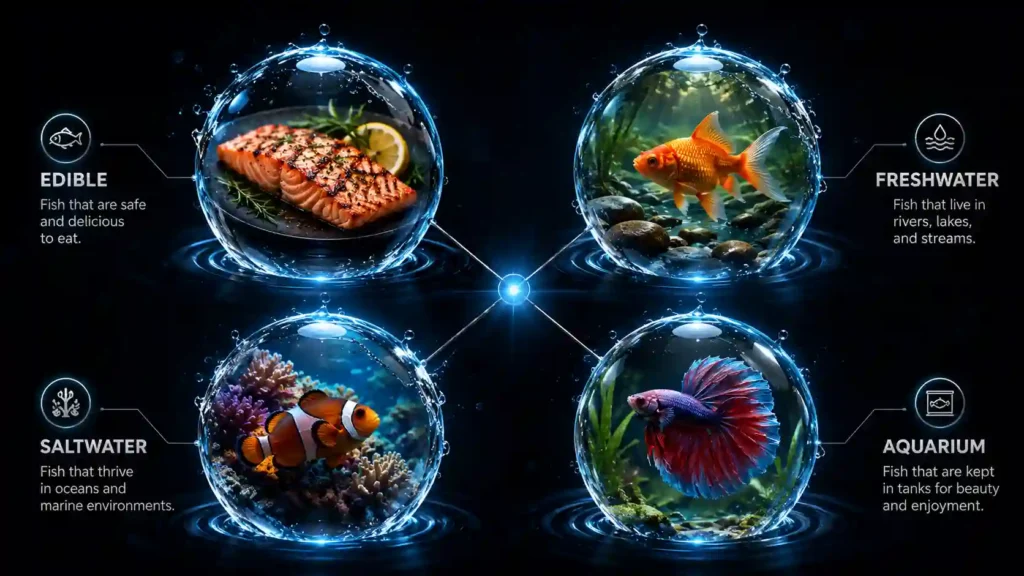
Fish are grouped in two different ways: by scientific classification and by everyday, practical use. For most readers, the practical grouping matters more, since it answers real questions like what to eat for dinner, where fish live in the wild, and which species make good pets.
Based on habitat and purpose, there are four main types of fish:
Edible fish, caught or farmed specifically for human consumption
Freshwater fish, living in rivers, lakes, ponds, and streams
Saltwater fish, thriving in oceans and seas with high salinity
Aquarium fish, kept in tanks for their color, beauty, and calming presence
These categories often overlap, and that overlap is one of the most confusing parts for beginners trying to understand fish for the first time. Salmon, for example, is both edible and capable of living in freshwater and saltwater during different life stages. Tilapia is freshwater and edible, and it also happens to be one of the most farmed fish species on the planet. Goldfish are freshwater and commonly kept in aquariums, yet almost nobody eats them, showing that a single species can belong to two categories while being completely irrelevant to a third.
Scientifically, fish also fall into three broader classes: bony fish (Osteichthyes), cartilaginous fish (Chondrichthyes) like sharks and rays, and jawless fish (Agnatha) like lampreys. This classification explains why fish vary so dramatically in skeleton structure, skin texture, and reproduction. A shark and a salmon, despite both being called fish, are built on completely different biological blueprints.
Understanding both systems, practical and scientific, gives a complete picture of how types of fish are organized and why certain species belong to more than one category. The rest of this guide walks through each practical category in detail, then circles back to the scientific classification for readers who want a deeper understanding.

Edible fish are species that are safe and popular for human consumption, prized for their protein content and mild to rich flavors depending on the species. They come from both freshwater and saltwater environments, and are sourced either through wild catch fishing or modern aquaculture, which now supplies more than half of the fish consumed worldwide, according to the Food and Agriculture Organization.
What makes edible fish nutritionally valuable is their combination of lean protein, healthy fats, and micronutrients that are hard to get from other food sources in the same balance. Unlike red meat, most edible fish are naturally low in saturated fat while still delivering a complete protein profile, which is why nutritionists consistently recommend fish as part of a balanced diet.
Edible fish are not a single uniform group. Some, like sardines and mackerel, are oily fish loaded with omega-3 fatty acids. Others, like cod and tilapia, are lean, mild-flavored white fish that work well in almost any recipe. This variety is part of why fish remains one of the most versatile proteins in global cuisine.
Some of the most widely eaten fish include:
Beyond these ten, other commonly eaten species include halibut, trout, swordfish, anchovy, and herring, each bringing its own flavor profile and culinary use to global kitchens.
Fish can provide high-quality protein, vitamins, minerals, and, in some species, omega-3 fatty acids. Fatty fish such as salmon, sardines, herring, and mackerel are particularly good sources of long-chain omega-3 fatty acids.
Fish can be part of a balanced diet, but nutritional value varies by species and preparation method. The American Heart Association recommends eating two servings of fish per week, particularly fatty fish.
When choosing seafood, consumers should also consider local food-safety guidance because some species can contain higher levels of mercury or other contaminants.
Beyond omega 3s, fish provides:
The American Heart Association recommends eating fish, particularly fatty species like salmon and mackerel, at least twice a week for cardiovascular benefits. Research published in cardiovascular health journals has repeatedly linked this eating pattern to a measurably lower risk of heart disease compared to diets low in fish.
It is worth noting that not all fish offer identical benefits. Oily fish like salmon, mackerel, and sardines contain significantly higher omega 3 levels than lean white fish like cod or tilapia, so if heart health is the primary goal, prioritizing fattier species makes a meaningful difference.
Not every edible fish is harvested the same way, and sourcing matters both for the environment and for the quality of what ends up on your plate. Wild caught fish, like most tuna and cod, are pulled directly from natural populations, while farmed fish, like most tilapia, catfish, and basa, are raised in controlled aquaculture systems.
Both methods have trade offs worth understanding:
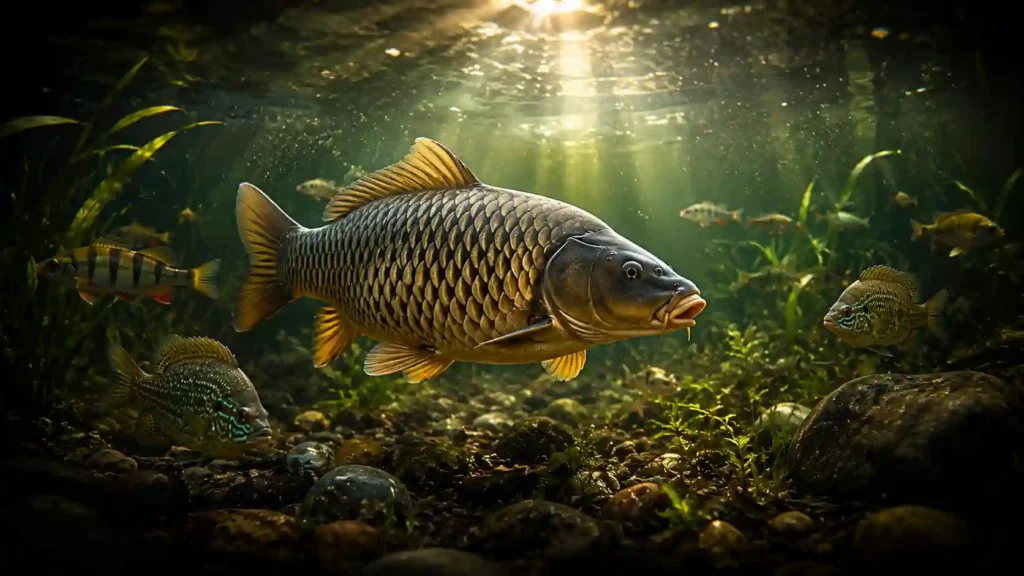
Freshwater fish are species that live in inland water bodies such as rivers, lakes, ponds, and streams, where salinity is very low compared to oceans. Most freshwater fish are adapted to low-salinity water and cannot tolerate full-strength seawater for extended periods. However, some species can tolerate or naturally move through brackish or marine environments during parts of their life cycle.
These fish are found on every continent except Antarctica and represent one of the most diverse groups in the animal kingdom, with new species still being discovered in remote river systems, particularly in the Amazon basin and parts of Southeast Asia where large stretches of river remain scientifically underexplored.
Freshwater fish generally fall into a few broad groups based on where they live and how they behave:
Water quality plays an outsized role in freshwater fish survival compared to their saltwater counterparts. Because rivers and lakes are more directly affected by pollution, agricultural runoff, and temperature changes from human activity, freshwater fish populations are often the first indicator of environmental problems in a region.
Some of the most recognized freshwater fish include:
Other notable freshwater species include trout, various carp varieties, and countless smaller schooling fish that form the base of freshwater food chains.
Freshwater fish serve several practical purposes beyond simply being a food source. They form the backbone of inland aquaculture, especially in countries like India, Bangladesh, and China, where carp farming alone feeds millions of people and supports significant portions of rural economies.
Freshwater fish are also central to:
In many developing regions, freshwater aquaculture has become a critical food security tool, since pond based fish farming requires far less infrastructure than marine aquaculture and can be implemented even in landlocked areas.
Freshwater fish face disproportionately high conservation pressure compared to many marine species, largely because rivers and lakes are smaller, more isolated ecosystems that recover more slowly from disturbance. According to conservation research bodies like the IUCN, freshwater species make up a significant share of documented fish population declines worldwide.
The main threats include:
National parks and protected river systems play an outsized role in preserving native freshwater fish diversity, since many of the world’s most geographically restricted species, isolated to a single spring, lake, or river stretch, exist nowhere else on the planet.
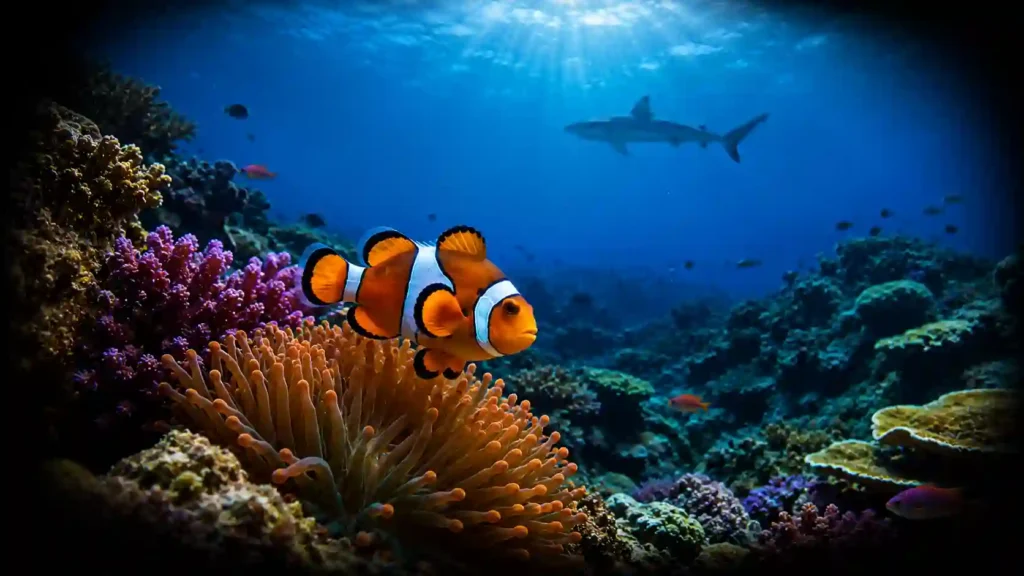
Saltwater fish, also called marine fish, live in oceans and seas where salinity levels are significantly higher than freshwater environments. To survive, these fish have developed specialized gills and kidneys that actively expel excess salt, an adaptation that freshwater species simply do not have and cannot develop over a single lifetime.
Marine environments are incredibly varied, and saltwater fish have adapted to thrive across all of them. Major habitats include:
This habitat diversity explains why saltwater fish display such extreme variation in size, from tiny reef gobies measuring under an inch to massive marlin weighing over a thousand pounds. It also explains why marine biologists estimate thousands of undiscovered species may still exist in the deep ocean, a habitat humans have explored less thoroughly than the surface of the moon.
Some of the most recognized saltwater fish include:
Other important saltwater species include swordfish, barracuda, and countless reef dwelling fish that together make coral ecosystems some of the most visually stunning habitats on Earth.
Saltwater fish support massive global industries that extend far beyond the dinner table. Commercial fishing fleets harvest species like tuna, mackerel, and snapper by the millions of tons annually to meet worldwide seafood demand, making marine fishing one of the largest food production systems on the planet.
Beyond food production, saltwater fish also drive:
Overfishing remains one of the biggest challenges facing saltwater fish populations today, with some species like Atlantic bluefin tuna facing significant population declines due to decades of high demand combined with slow reproduction rates.
Unlike freshwater systems, which are often managed at a local or national level, saltwater fisheries frequently require international cooperation, since fish populations regularly cross national maritime boundaries as they migrate. Organizations like NOAA Fisheries in the United States and regional fisheries management bodies set catch limits designed to keep populations at sustainable levels.
Modern fisheries management typically relies on a combination of:
These management tools have shown measurable success in some regions. Certain rebuilt fish stocks, once considered severely depleted, have recovered significantly after sustained catch limit enforcement, demonstrating that saltwater fish populations can bounce back when given the chance under well designed regulation.
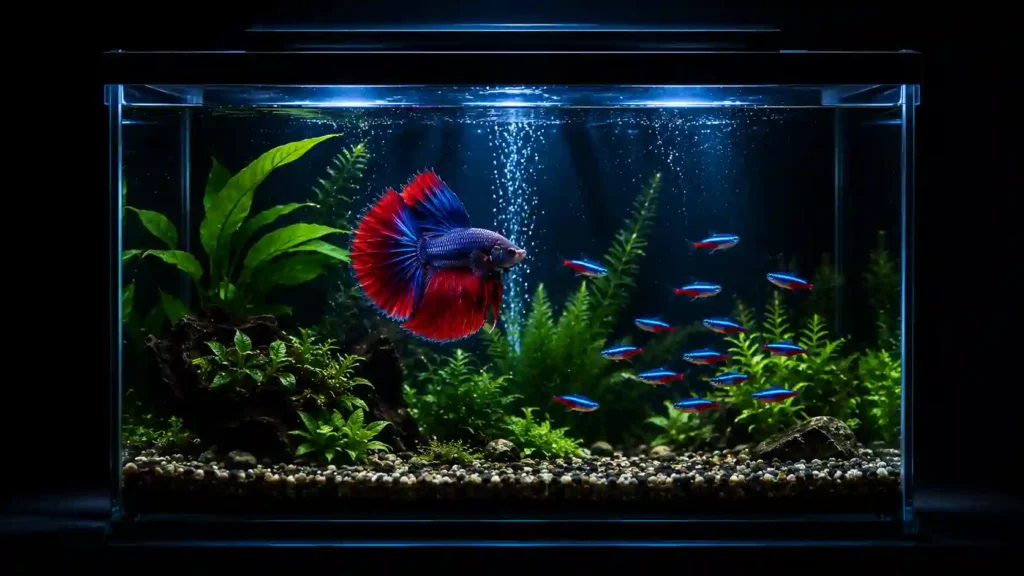
Aquarium fish are species kept in tanks purely for decorative and companionship purposes, prized for their color, movement, and relatively low maintenance compared to other pets. They can come from either freshwater or saltwater environments, though freshwater species dominate the hobby because they are easier and cheaper to maintain, requiring less specialized equipment and more forgiving water parameters.
Beyond looking good in a living room or office, aquarium fish offer genuine wellbeing benefits that go beyond simple aesthetics. Studies on fish tank ownership have linked watching fish swim to lower stress and reduced blood pressure, which is part of why aquariums remain popular in homes, offices, dental waiting rooms, and even hospital settings where a calming visual focus can measurably reduce anxiety.
The aquarium hobby has also grown significantly as an accessible entry point into animal care, since even a basic setup can introduce beginners, including children, to concepts like water chemistry, feeding schedules, and habitat maintenance.
Some of the most popular aquarium fish include:
Cardinal tetras, zebra danios, and swordtails round out the list of consistently popular choices, particularly for hobbyists building colorful community tanks.
Freshwater aquarium fish are generally easier to care for, more affordable, and more forgiving of beginner mistakes, which is why most first time fish keepers start there. A basic freshwater setup can be running successfully within a few weeks, while saltwater tanks typically require a longer cycling period and more precise monitoring before fish can be safely introduced.
Saltwater aquarium fish, like clownfish and tangs, are visually stunning but require precise salinity control, specialized equipment such as protein skimmers, and a noticeably higher budget for both setup and ongoing maintenance. Coral based saltwater tanks add another layer of complexity, since corals are far more sensitive to water quality fluctuations than most fish.
For beginners, freshwater species like guppies, platies, and bettas offer the best starting point since they tolerate a wider range of water conditions and are more resistant to common mistakes like inconsistent feeding or minor temperature swings. Once a hobbyist has built confidence managing a freshwater tank, transitioning to saltwater becomes a much more manageable next step.
Setting up a healthy first aquarium comes down to a handful of fundamentals that make the difference between a thriving tank and a stressful, short lived hobby. Getting these basics right before adding fish prevents most of the common problems new hobbyists run into.
Keep these essentials in mind:
A well planned setup with the right filtration and a manageable number of hardy species gives new aquarium owners the best chance of long term success, both for the fish and for their own enjoyment of the hobby.
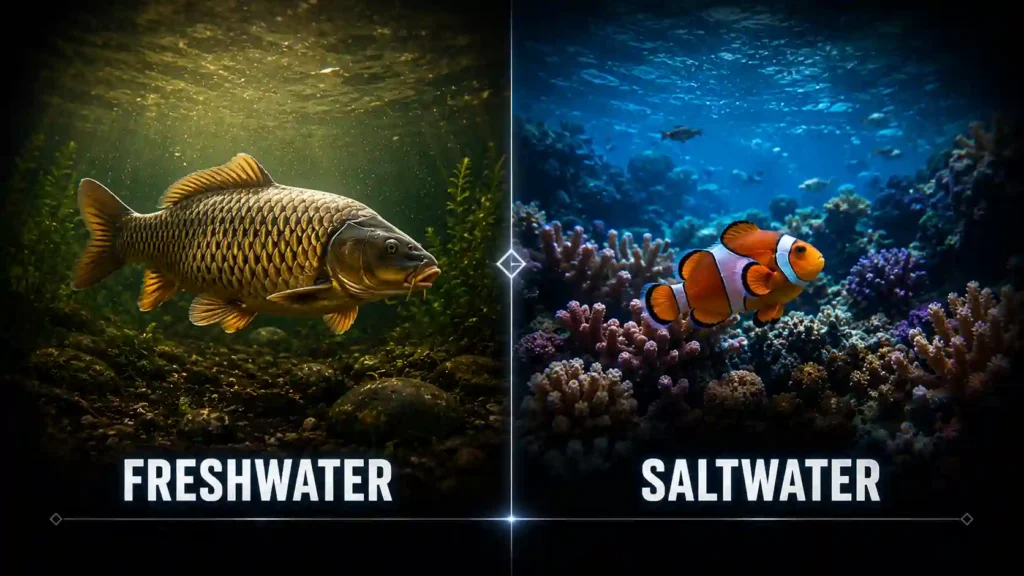
The core difference between freshwater and saltwater fish comes down to osmoregulation, meaning how their bodies manage salt and water balance. Freshwater fish constantly absorb water through their skin and gills and must expel excess fluid through diluted urine, while saltwater fish lose water to their environment through osmosis and must actively drink seawater and excrete concentrated salt through specialized gill cells. This single biological difference explains nearly every other distinction between the two groups.
Feature | Freshwater Fish | Saltwater Fish |
Habitat | Rivers, lakes, ponds, streams | Oceans, seas, coral reefs |
Salinity tolerance | Low salinity | High salinity |
Body adaptation | Absorb water, expel salt | Retain water, expel excess salt |
Species diversity | Around 15,000 species | Around 15,000 to 20,000 species |
Common examples | Rohu, Catla, Carp, Perch | Tuna, Marlin, Snapper, Grouper |
Aquarium difficulty | Easier for beginners | Requires more equipment and expertise |
Farming and aquaculture | Widely farmed in ponds | Farmed mainly in coastal cages |
Typical lifespan in captivity | Often longer, more forgiving | Often shorter without ideal conditions |
Water change sensitivity | More forgiving of fluctuations | Highly sensitive to salinity swings |
A small number of species, known as diadromous fish, are capable of moving between freshwater and saltwater during different life stages, an ability that requires an unusually flexible osmoregulation system. Salmon are the best known example, born in freshwater rivers, migrating to the ocean to mature over one to several years, then returning to the exact freshwater river of their birth to spawn, guided by a combination of magnetic sensing and scent memory. Certain eel species do the opposite, spending most of their adult lives in freshwater rivers before migrating to the ocean to breed.
Understanding this difference matters well beyond biology class. It affects everything from which fish farmers can raise in inland ponds versus coastal cages, to which species aquarium hobbyists can safely keep together, to how fisheries manage sustainable catch limits across different water types. It also explains why moving a saltwater fish into a freshwater tank, or vice versa, is almost always fatal within hours, since the sudden reversal of osmotic pressure overwhelms the fish’s regulatory system entirely.
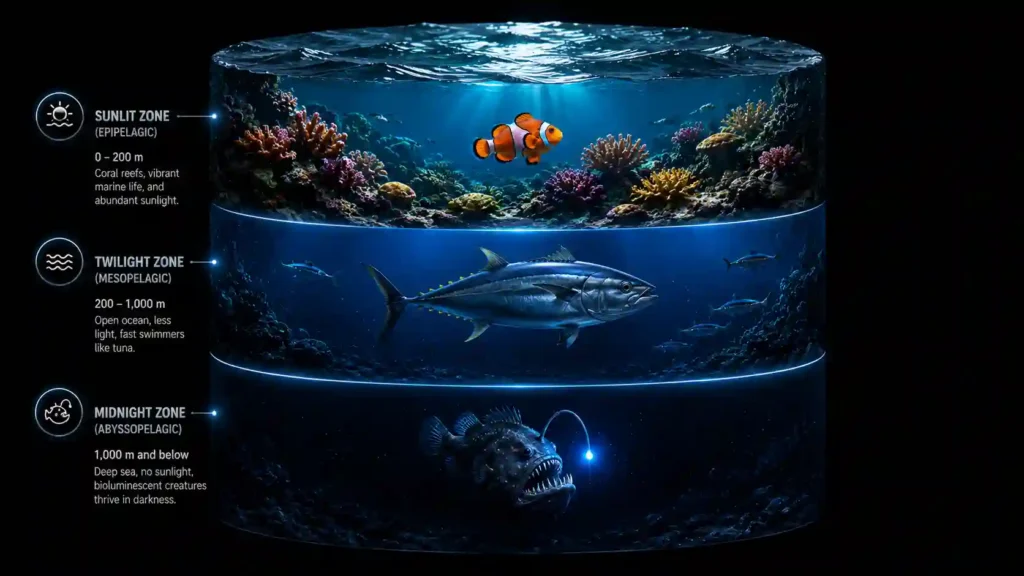
Beyond the freshwater and saltwater divide, fish are also classified by more specific habitat zones, which helps explain why certain species never cross paths even within the same broader water type. This habitat based classification is especially useful for understanding fish behavior, distribution patterns, and why two saltwater fish can require completely different care in captivity.
The main habitat categories include:
Coastal habitats alone support over 180 documented fish species in some regional biodiversity databases, making them one of the richest zones for fish diversity on the planet, largely due to the combination of nutrient rich water, varied shelter, and access to both marine and freshwater food sources.
This habitat based lens matters because two fish from the same broad category, like saltwater fish, can have completely different care needs, diets, and behaviors depending on whether they live in a coral reef or the open ocean. A reef fish like a clownfish needs shelter, stable temperatures, and a relatively small territory, while a pelagic species like tuna needs constant movement and vast open space, making the two essentially incompatible in any shared environment, whether in the wild or in captivity.
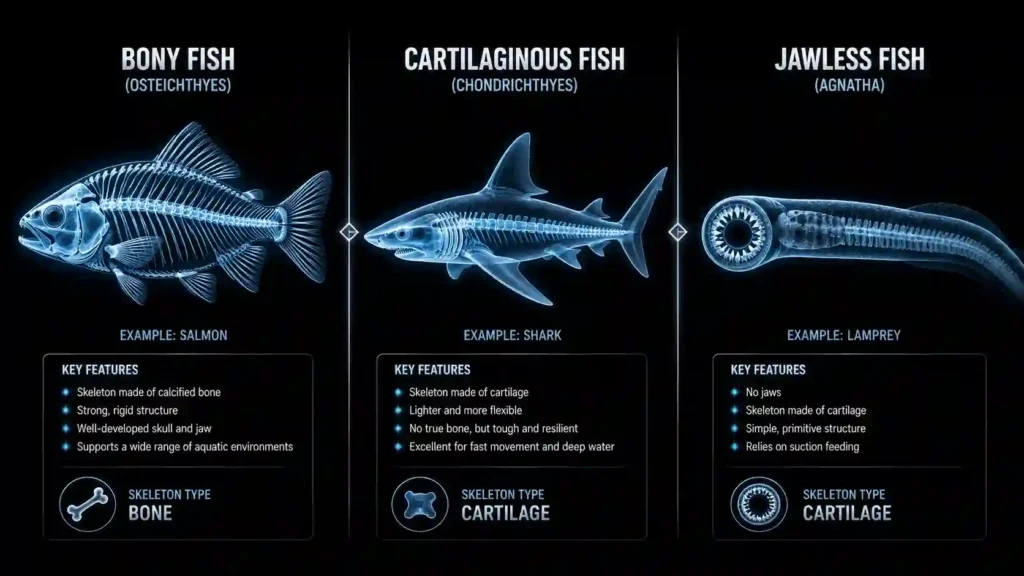
Fish are a diverse group of aquatic vertebrates. Living fish are commonly discussed in three major groups: jawless fish, cartilaginous fish, and bony fish.
Jawless fish include lampreys and hagfish.
Cartilaginous fish include sharks, rays, and skates.
Bony fish include the vast majority of familiar fish species, such as salmon, tuna, goldfish, and many aquarium fish.
This scientific grouping is different from the practical categories used in this guide. A fish can be freshwater, edible, or kept in an aquarium regardless of its scientific group.
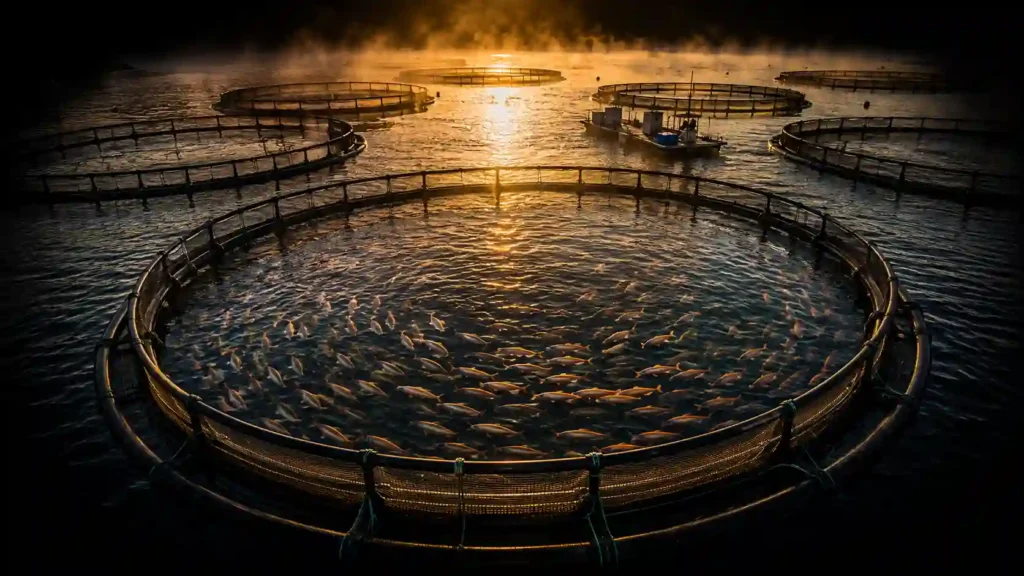
Aquaculture, the farming of fish and other aquatic organisms, has grown into one of the fastest expanding food production sectors in the world. According to the Food and Agriculture Organization, farmed fish now account for more than half of all fish consumed globally, a dramatic shift from just a few decades ago when wild catch dominated the seafood supply.
This growth has been driven by several factors:
Freshwater aquaculture, particularly carp and tilapia farming, dominates production by volume, largely concentrated in Asia, where countries like China, India, and Bangladesh account for the majority of global output. Saltwater aquaculture, including farmed salmon and shrimp, has also expanded significantly, particularly in coastal regions of Norway, Chile, and Southeast Asia.
Despite its benefits, aquaculture is not without challenges. Poorly managed farms can contribute to water pollution, disease spread among densely stocked fish, and habitat destruction when coastal mangroves are cleared to make room for farming ponds. The industry’s ongoing shift toward better regulated, more sustainable practices reflects growing recognition that long term aquaculture growth depends on protecting the same ecosystems it relies on.
For consumers, understanding whether a fish is wild caught or farmed, and under what conditions, has become an increasingly relevant part of making informed, responsible seafood choices.
Fish can be grouped in several useful ways. In this guide, we looked at four practical categories: edible fish, freshwater fish, saltwater fish, and aquarium fish. These categories can overlap, so the same species may appear in more than one group.
Understanding the difference between habitat, human use, and scientific classification makes it easier to identify fish and find the right information about their diet, environment, care, or use.
For species-specific information, explore the individual fish guides on Fish Info Guide.
What are the main types of fish?
Fish can be grouped in several ways. For this guide, the main practical categories are edible fish, freshwater fish, saltwater fish, and aquarium fish. These categories are based mainly on how people use fish and where they live. They can overlap, so one species may belong to more than one category.
What is the difference between freshwater and saltwater fish?
Freshwater fish live mainly in rivers, lakes, ponds, and other low-salinity environments. Saltwater fish live mainly in oceans and seas, where the water contains much more salt. Their bodies are adapted to regulate water and salt differently according to their environment.
Which fish are commonly eaten?
Commonly eaten fish include salmon, tuna, cod, tilapia, catfish, sardines, mackerel, trout, carp, and haddock. The types of fish people eat vary by country, local availability, fishing practices, and food culture.
What are aquarium fish?
Aquarium fish are fish kept in home or public aquariums for ornamental, educational, or hobby purposes. Popular examples include goldfish, bettas, guppies, angelfish, neon tetras, mollies, platies, and corydoras. Aquarium fish can be freshwater or saltwater species.
Can a fish belong to more than one category?
Yes. Fish categories can overlap. For example, goldfish are freshwater fish and aquarium fish, while tilapia is a freshwater fish that is also commonly raised for food. Some species can also move between freshwater and saltwater during different stages of their life.
What are the main scientific groups of fish?
Living fish are commonly discussed in three major groups: jawless fish, cartilaginous fish, and bony fish. Jawless fish include lampreys and hagfish, cartilaginous fish include sharks and rays, and bony fish include species such as salmon, goldfish, tuna, and many aquarium fish.
Can freshwater fish live in saltwater?
Most freshwater fish are adapted to low-salinity water and cannot safely live in full-strength seawater for long periods. A sudden change in salinity can cause severe stress because their bodies are adapted to a particular water balance. However, some species can tolerate or naturally move through brackish or marine environments.
What are some beginner-friendly aquarium fish?
Some commonly recommended beginner-friendly freshwater fish include guppies, platies, mollies, zebra danios, and some types of tetras. However, beginner suitability also depends on tank size, water quality, temperature, compatibility, and proper care.

Fish Info Guide helps you explore edible, freshwater, saltwater, and aquarium fish – with simple guides on nutrition, care, and species identification for beginners and enthusiasts alike.
Imortant Links
Quick Links
Subscribe Our Newsletter
Get the latest fish care tips, species guides, and nutrition insights delivered straight to your inbox.